MENU
Close





Would you eagerly trade your family name, your spotless reputation, and your very face for one breathless night of absolute, ruinous freedom, once vizard masks made you anonymous enough to vanish into a stranger’s arms?
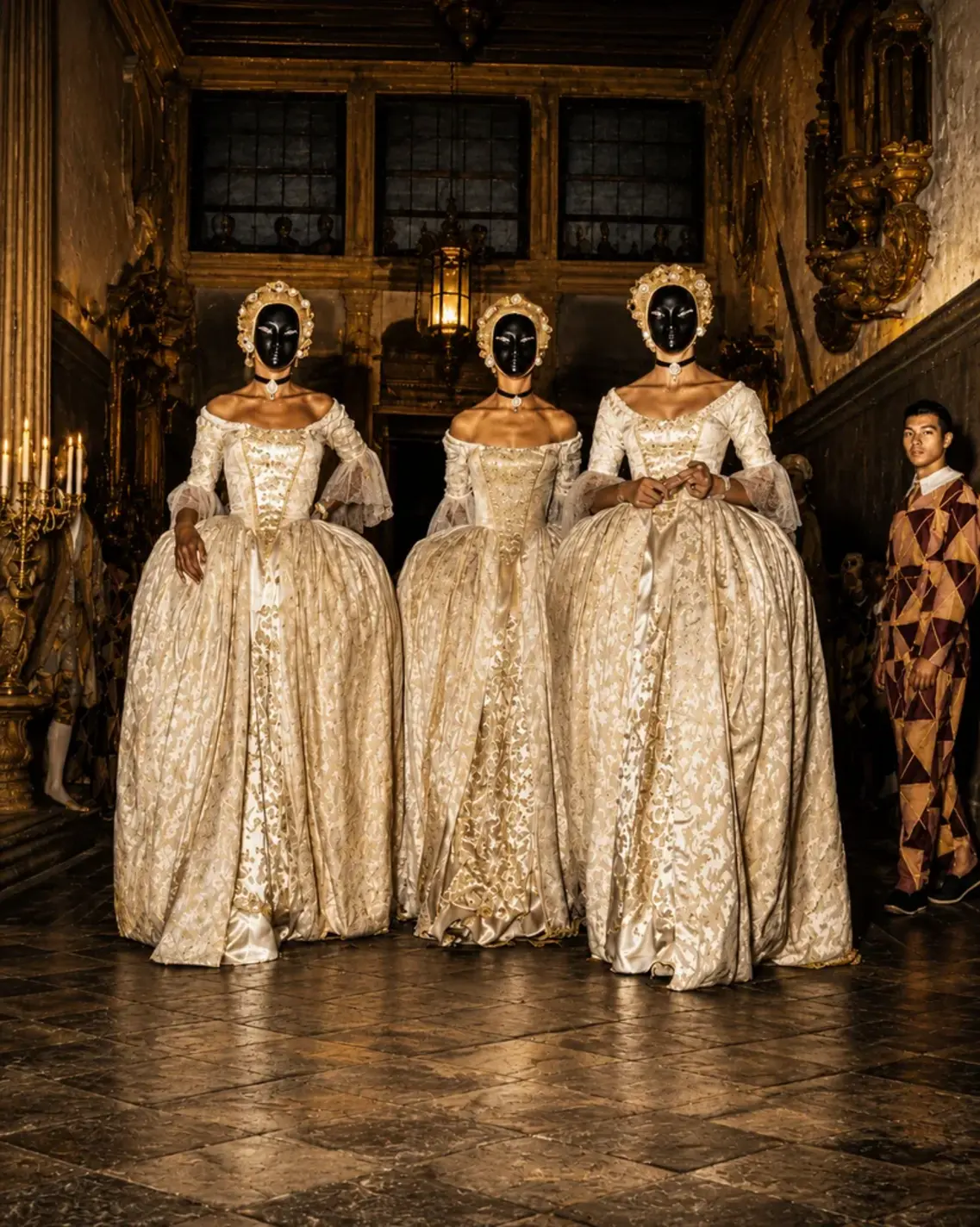
Would you eagerly trade your family name, your spotless reputation, and your very face for one breathless night of absolute, ruinous freedom, once vizard masks made you anonymous enough to vanish into a stranger’s arms?
May 29, 2026
Advertisement

Advertisement



The sixteenth century gave birth to a calculated obsession with erasure. Across the glittering, hyper-surveilled courts of London, Paris, and Venice, wealthy women began willfully deleting their own features behind sheets of black velvet. At a time when a stray sunbeam or a splash of dust could permanently ruin a woman’s social currency by staining her skin with the vulgar tan of a peasant laborer, the elite chose to turn themselves into ghosts.
But the true scandal of the vizard masks was not what it kept out, it was the intoxicating, lawless freedom it let in. When a woman put on the mask, she stripped away the crushing societal expectations of her name, her lineage, and her virtue, transforming into a walking enigma. She could glide through the filthy, chaotic streets or sit in a crowded playhouse entirely unmoored from her reputation, possessing a hidden identity that drove the patriarchal establishment into a state of moral panic.
The mechanics of this concealment were brutally intimate, almost erotic in their restraint: full-face vizards were completely stringless, held fast against the visage only because the wearer gripped a small glass bead between her teeth. To speak was to drop the vizard masks; to retain her mystery, she had to choose absolute, unbroken silence. It was a fiercely powerful, quiet rebellion wrapped in velvet, rendering women entirely unreadable in a world that demanded they be perfectly possessed.

Naturally, this sudden epidemic of faceless women whipped moral puritans and self-appointed cultural watchdogs into a frenzy of terrified outrage. In 1583, the Puritan reformer Philip Stubbes weaponized his pen in The Anatomie of Abuses, frantically warning that a decent man walking down the street might suffer a heart attack upon encountering these monstrous creatures who possessed bodies but no faces.
The institutional fear was palpable: a woman who could not be identified could not be controlled, and critics instantly equated the vizard masks with profanity, unchecked sexual pleasure, and a terrifying slide into moral excess. If a woman's face was her moral contract with society, tearing it up was an act of war. Even the French nickname for the half-mask, the loup, or wolf, betrayed the culture's deep anxiety, framing these stylish women not as passive beauties, but as predators stalking the night, using their concealed gaze to upend the social hierarchy.
This high-stakes game of hide-and-seek reached an even more haunting, minimalist peak in the deeply Catholic courts of Spain through the art of el tapado. Here, the vizard masks was traded for the heavy, suffocating architecture of the dark mantle, a garment draped so aggressively over the head and body that it compressed a woman's entire existence down to a single, uncovered eye. It was an aesthetic stripped to its absolute bare essentials, mysterious, exposed, yet entirely unreachable.
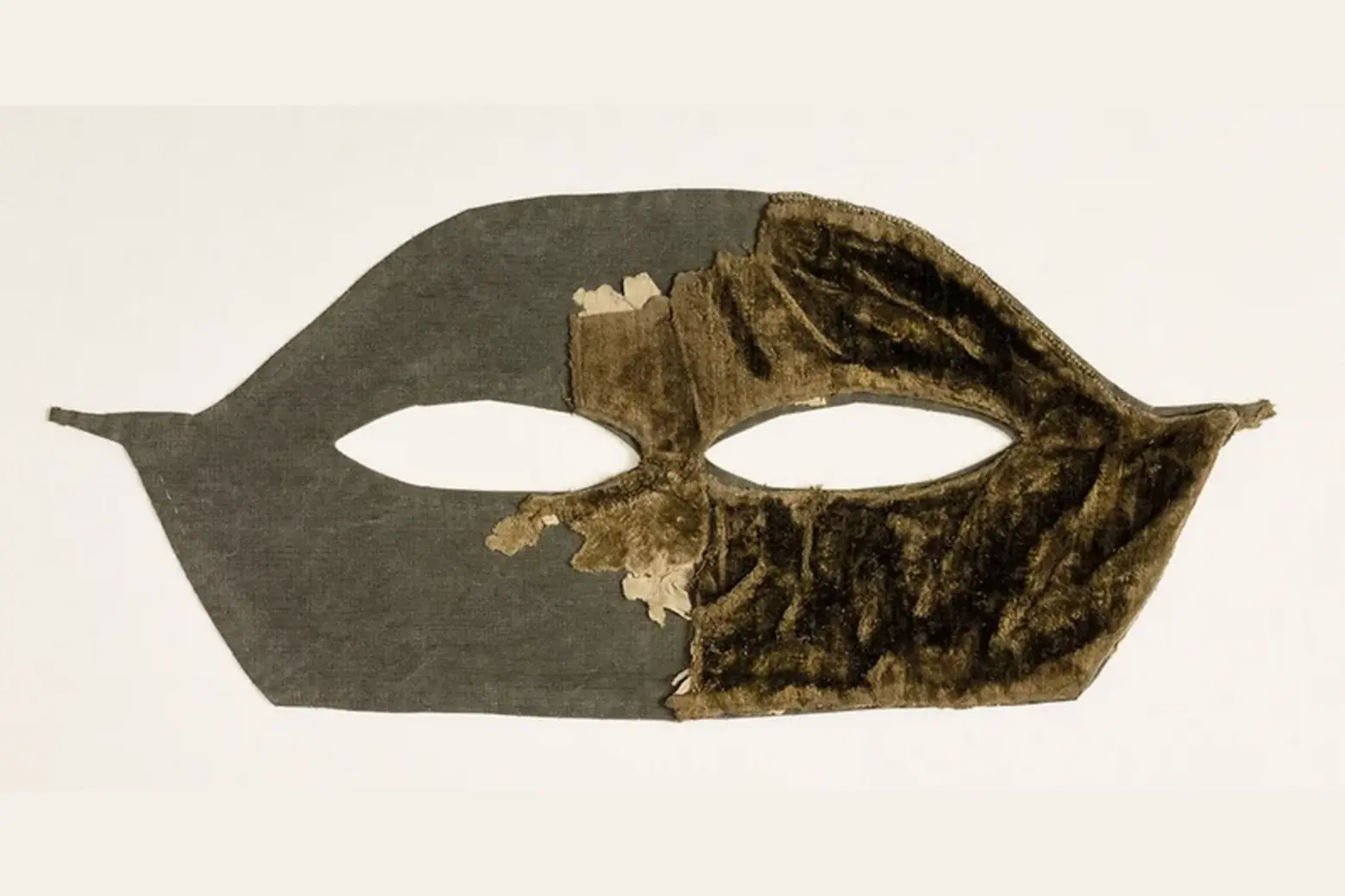
Decades later, a pristine artifact of this era, a 16th-century vizard masks made of black velvet, pressed paper, and white silk, was found literally bricked up inside the stone walls of a house in Daventry, England. It is a profoundly romantic, chilling image: a piece of forbidden history hidden away like a skeleton or a dark secret, a physical remnant of a time when women had to literally bury their faces in the architecture just to keep a piece of themselves entirely their own.
As the seventeenth and eighteenth centuries dawned, the playhouses of European capitals morphed into arenas of voyeurism and elite posturing, where the act of watching the audience became just as potent as watching the stage. In June of 1663, the notorious English diarist Samuel Pepys sat in the Theatre Royal and watched Lady Mary Cromwell deliberately strap on her full-face vizard masks the moment the house began to suffocate with people, keeping it clamped tight throughout the entire performance, a provocative act he noted was fast becoming the ultimate weapon of high-fashion evasion. On the surface, academic consensus, like that of scholar Will Pritchard, suggests this was a desperate shield for a woman's modesty; the stage was dripping with dirty double entendres and raw, suggestive language that should have made a respectable woman blush.
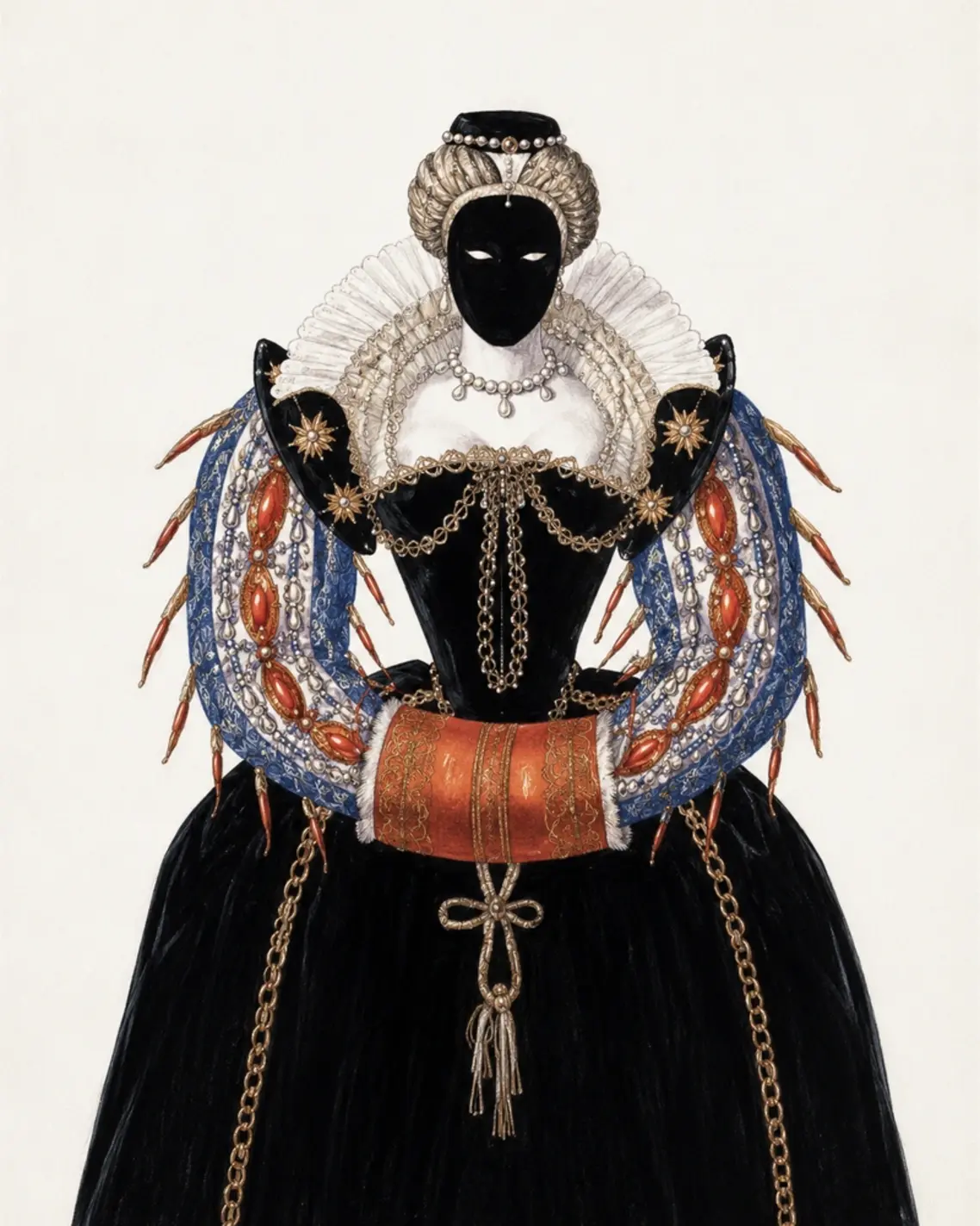
As the trend bled into the hyper-regulated court of France, vizard masks evolved into a highly weaponized, intensely erotic ritual of power and submission. By 1695, Paris guides were forced to publish strict manuals of etiquette to contain the chaotic energy of the faceless elite, dictating that keeping vizard masks on in the presence of royalty or social superiors was an unforgivable act of political defiance. You had to strip your face bare before a king, and to curtsy while masked was viewed as a grotesque breach of manners unless done from a safe, sterile distance.

But the aristocracy was already hooked on the intoxicating illusion of total anonymity. The mask altered the physics of human interaction; it forced the world to guess, to ache, to imagine what lay beneath the velvet skin. It was an explicitly exposed state of mystery that playwrights like Edward Ravenscroft seized upon in his 1673 comedy The Careless Lovers, celebrating how vizard masks allowed wives, daughters, and nieces to slip into the intoxicating underworld of plays, balls, and masquerades completely undetected by the men who claimed to own them. This was the birth of going incognito, a word stolen from the Italians to describe a state of being beautifully, dangerously unmoored from one's own name.

By the 1700s, this collective fever dream found its absolute capital in Venice. Driven by the lawless euphoria of Carnival, vizard masks spilled out of the theaters and flooded every artery of Venetian life, from the elite cafés to the public squares. Wealthy women paraded in the moretta, a haunting Venetian mutation of the vizard, paired with sweeping wide-brimmed hats and heavy veils, while men and women alike adopted the stark white half-mask known as the maschera, aggressively tucked into black tricorn hats. Vizard masks became the ultimate equalizer and the ultimate corruptor. It allowed the saint and the sinner, the noble and the peasant, to brush shoulders in the dark, blending identities until the boundaries of class and virtue dissolved entirely. It was a culture stripped bare of its rules, operating under the heavy, romantic delusion that when everyone is wearing a mask, everyone is finally telling the truth.
The high-born ladies who used the vizard masks to protect their modesty were suddenly joined in the shadows of the playhouses and gambling dens by the city’s sex workers, who instantly weaponized the trend. By donning the exact same expensive vizard masks and garb as the nobility, these women of the night turned a simple evening out into a destabilizing guessing game that left the patriarchy sweating. Suddenly, no man could tell the duchess from the courtesan. John Dryden perfectly captured this raw, seductive chaos in his 1670 play The Conquest of Granada, celebrating the vizard mask as fashion’s ultimate engine of desire, a device designed specifically to ignite the male imagination by offering everything and revealing nothing. It was an aesthetic of pure provocation, where the bare truth of a woman's identity was completely erased, leaving men to obsess over the tantalizing mystery of who, exactly, was sitting beside them in the dark.
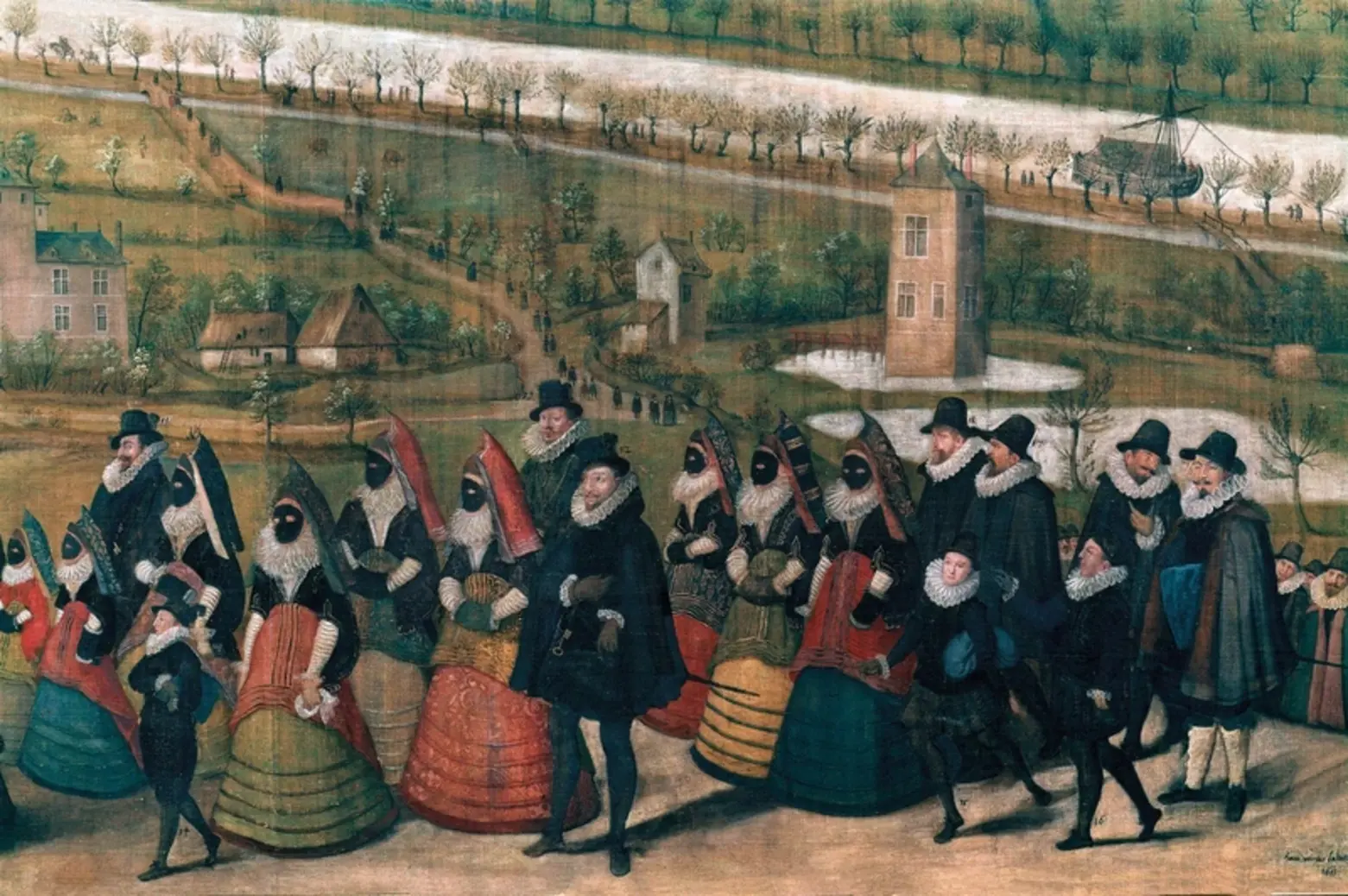
Of course, a society built on rigid class control could not tolerate such a lawless blurring of lines for long. By the turn of the eighteenth century, the word "vizard" had completely shed its aristocratic sheen and plummeted into the gutter, becoming literal street slang for a prostitute. The establishment panicked; Queen Anne, utterly scandalized by this democratic explosion of vice, declared that the full-face mask was actively corrupting the empire, and in 1704 she officially banned vizards from English theaters altogether. This heavy-handed state censorship successfully branded the mask with a permanent scarlet letter, driving it out of London’s circles as respectable women scrambled to distance themselves from the stigma of the streets.
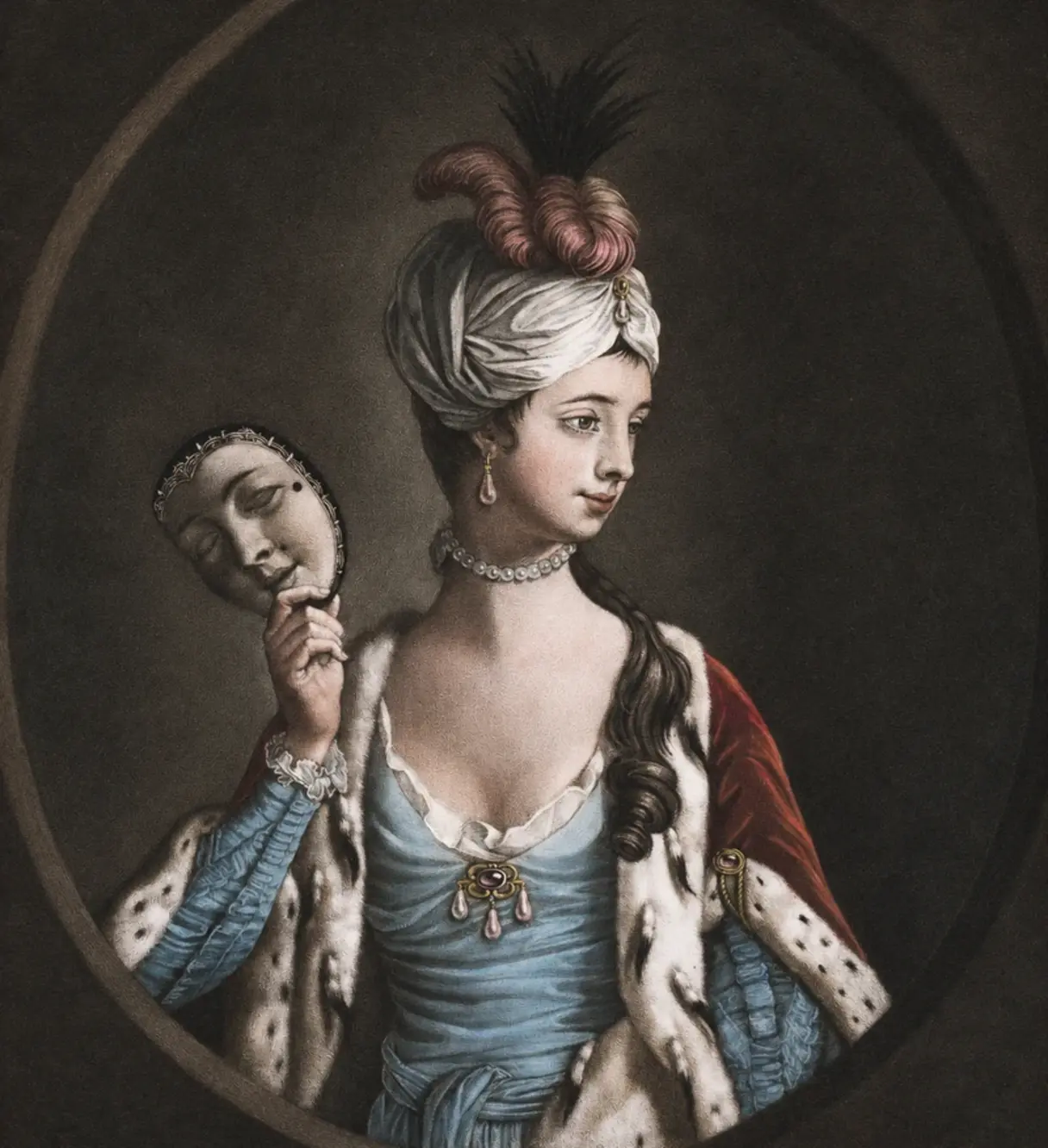
Across the continent, Venice was locked in its own manic, centuries-long identity crisis regarding the mask, swinging wildly between puritanical rage and state-mandated indulgence. In 1608, Venetian authorities sought to brutally enforce respectability by decreeing that any sex worker caught masquerading as an honest woman would be dragged to the entrance of Piazza San Marco and chained for two agonizing hours between the public execution columns.
By 1776, the infamous Council of Ten took the madness even further, issuing a desperate decree ordering all nobles to wear masks to combat a rampant, dangerous wave of immodesty sweeping through the upper classes. The city had become so fundamentally warped by the theater of concealment that the state believed the only way to save its virtue was to force everyone to lie. This manic obsession was fueled by Carnival, the annual pre-Lent explosion of hedonism where elaborate face coverings allowed Venice to indulge its darkest impulses. Though this legendary tradition was brutally crushed by Napoleon’s invasion in 1797, initiating a dark, centuries-long hibernation that lasted until its revival in the 1970s, vizard masks had already etched itself into the global psyche. Meanwhile, in mid-eighteenth-century Paris, the fad finally burned itself out. As scholar Joan DeJean notes, the birth of the modern city had awakened a hunger for a more fluid, liberated way of moving through the world, leaving the vizard behind as a beautiful, relic of a time when freedom had to be stolen in the dark.
Advertisement