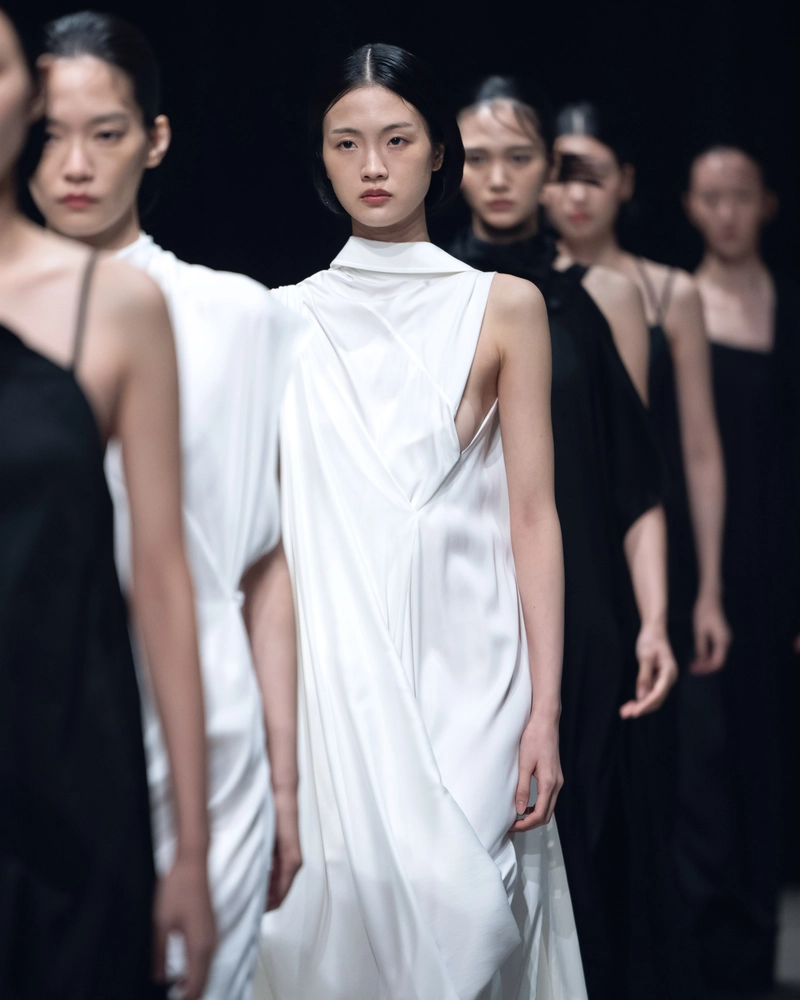
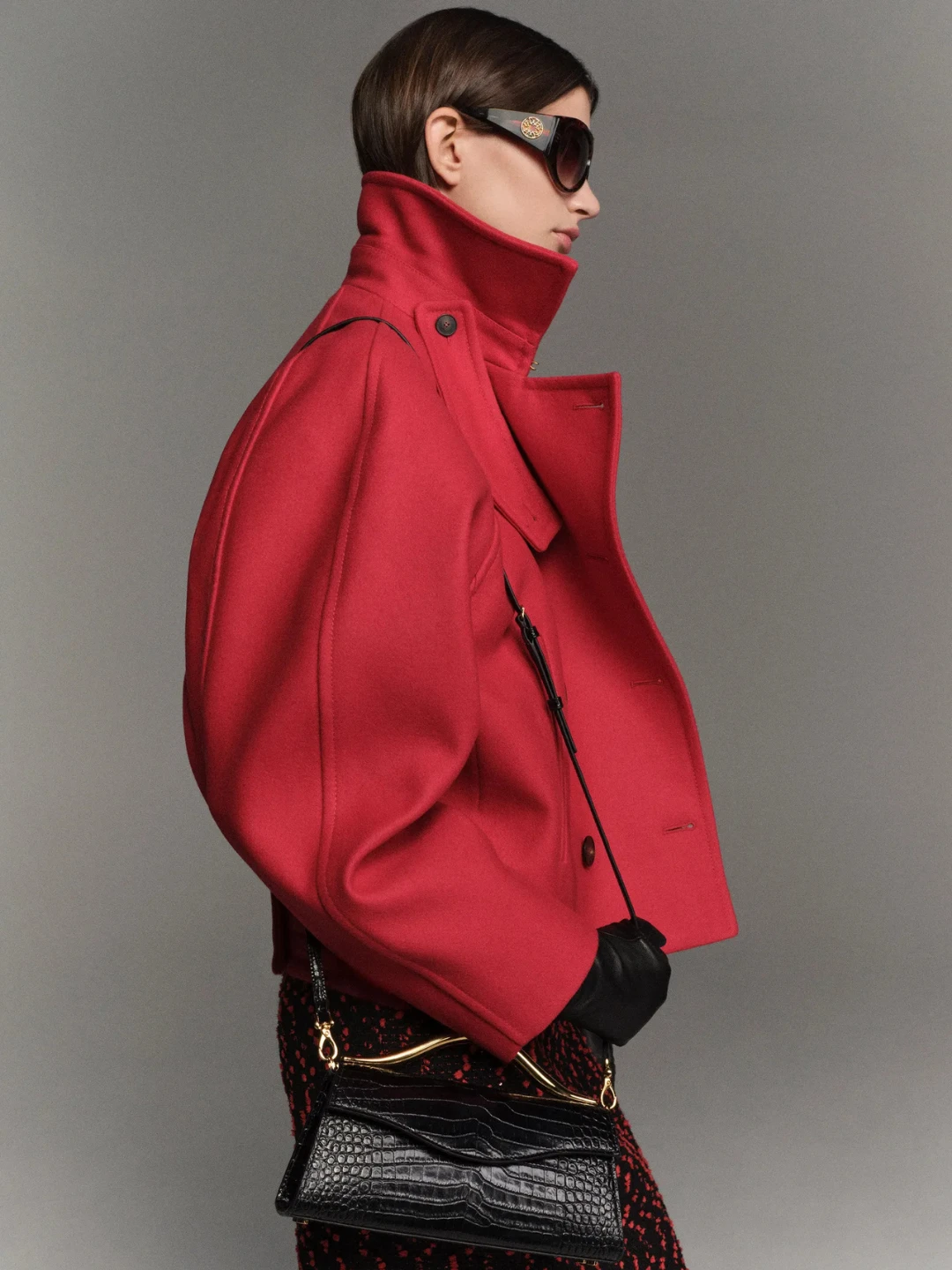
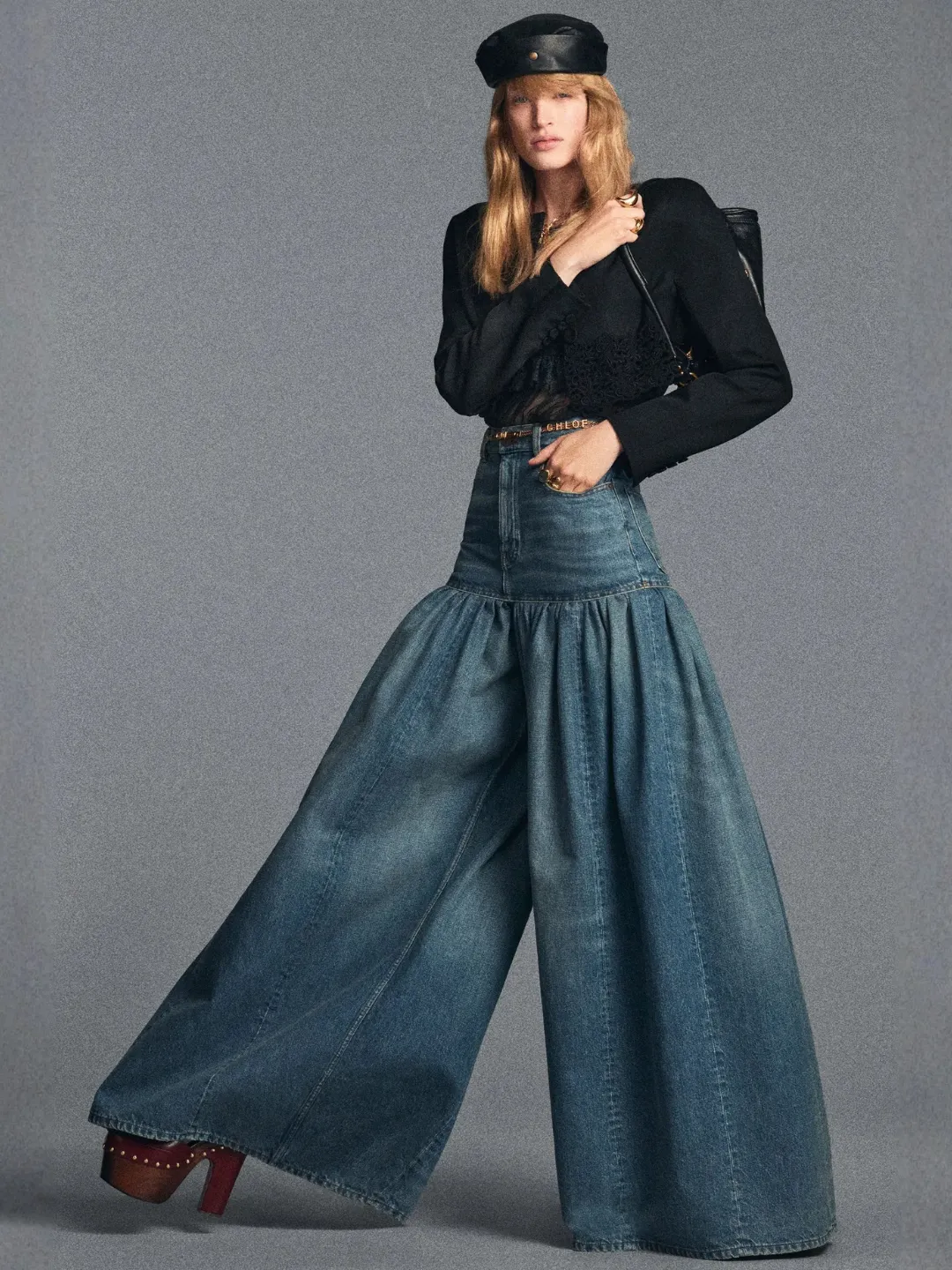
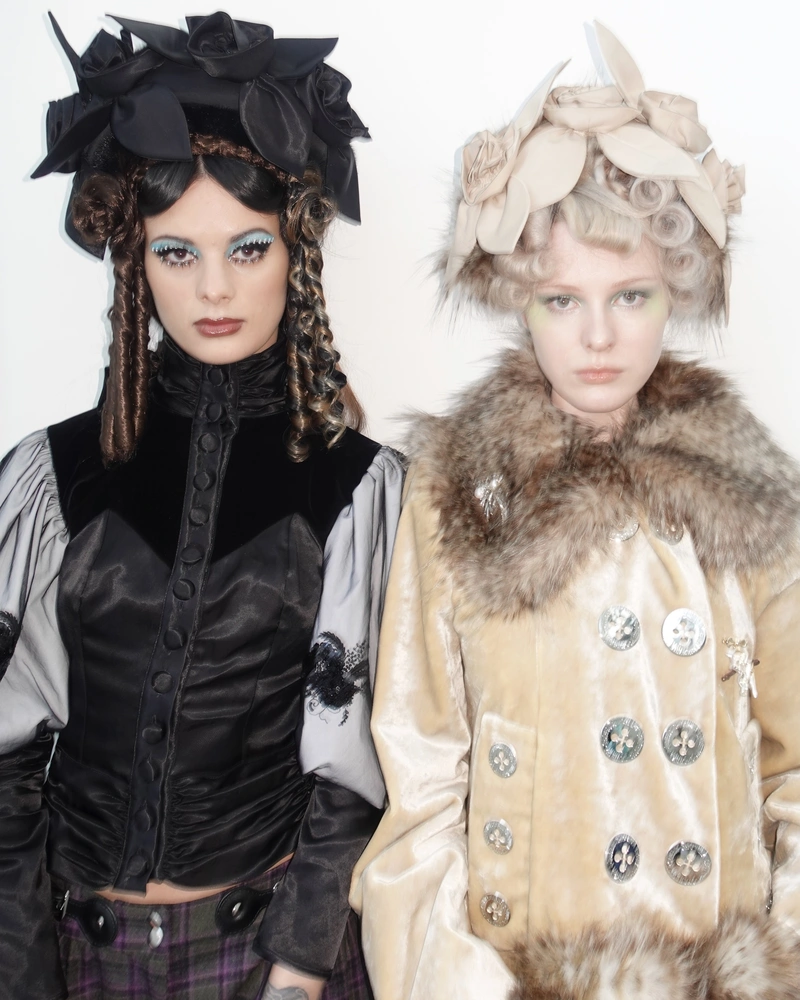
Louis Vuitton Fall 2026 by Nicolas Ghesquière begins with a breathtaking proposition: that the first designer was never man, but the mountain itself.
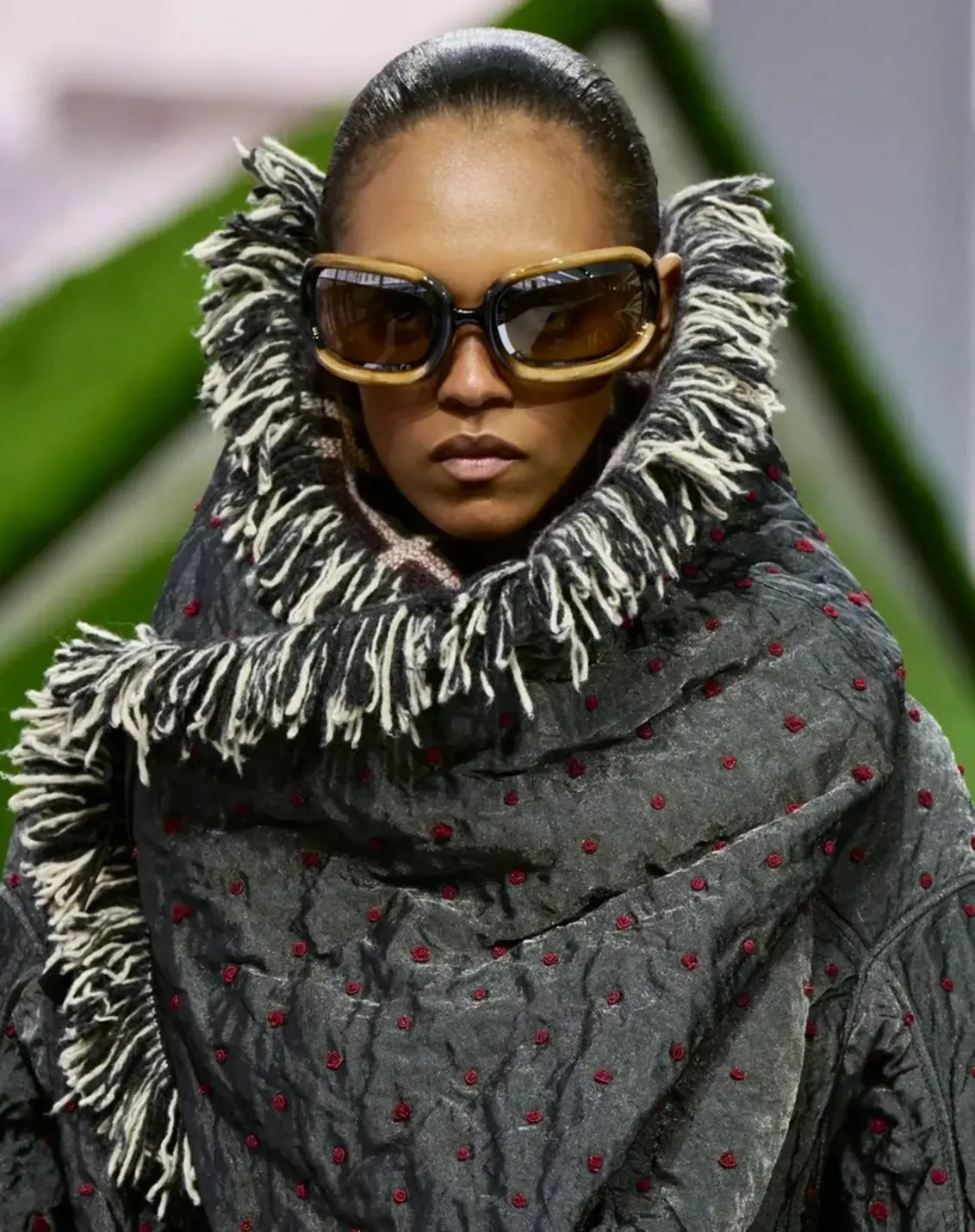
Louis Vuitton Fall 2026 by Nicolas Ghesquière begins with a breathtaking proposition: that the first designer was never man, but the mountain itself.
March 16, 2026
Advertisement

Advertisement



From that idea, everything follows, the sheltering coats, the furred shoulders, the stick-borne bags, the bells, the strange hats lifted toward the sky, the silhouettes that look as if they were cut by wind and held together by memory. Inside the Louvre, nature did not arrive as scenery or sentimental escape. It arrived as force: cold, pastoral, nomadic, and magnificent enough to remake the body in its image. This was folklore returning as instinct, as survival translated into luxury by a designer who has always known that proportion can feel like destiny.
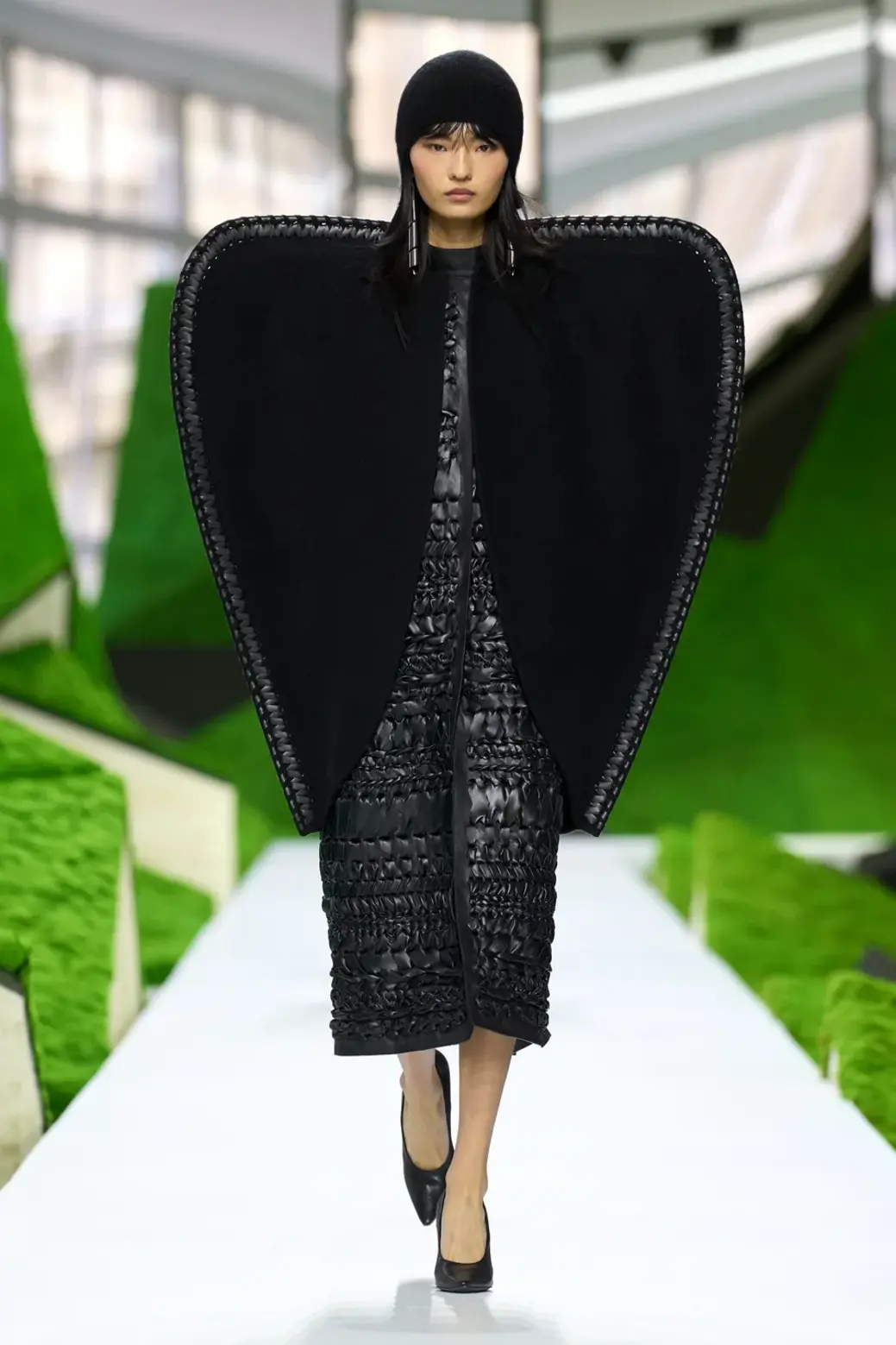
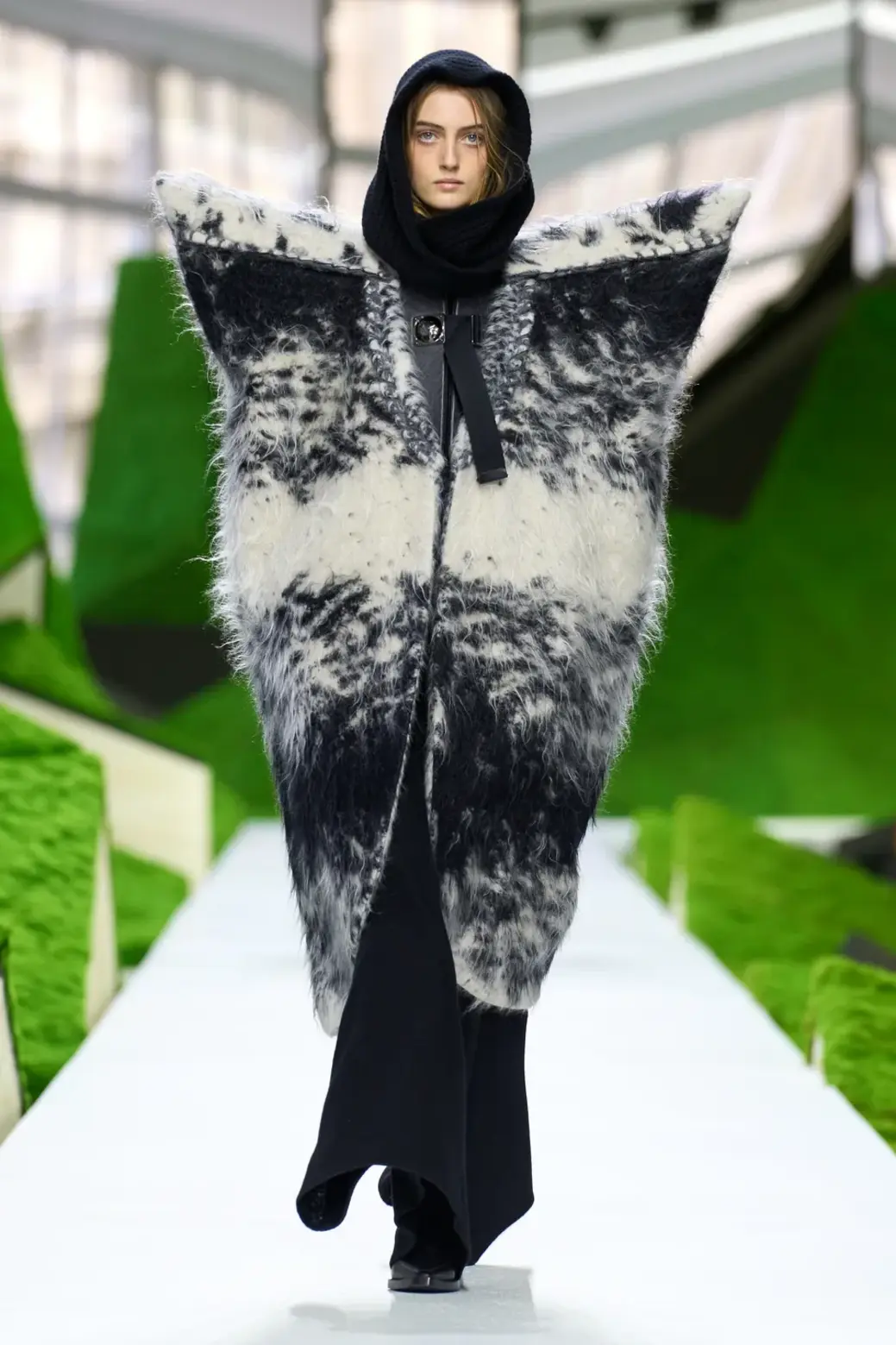
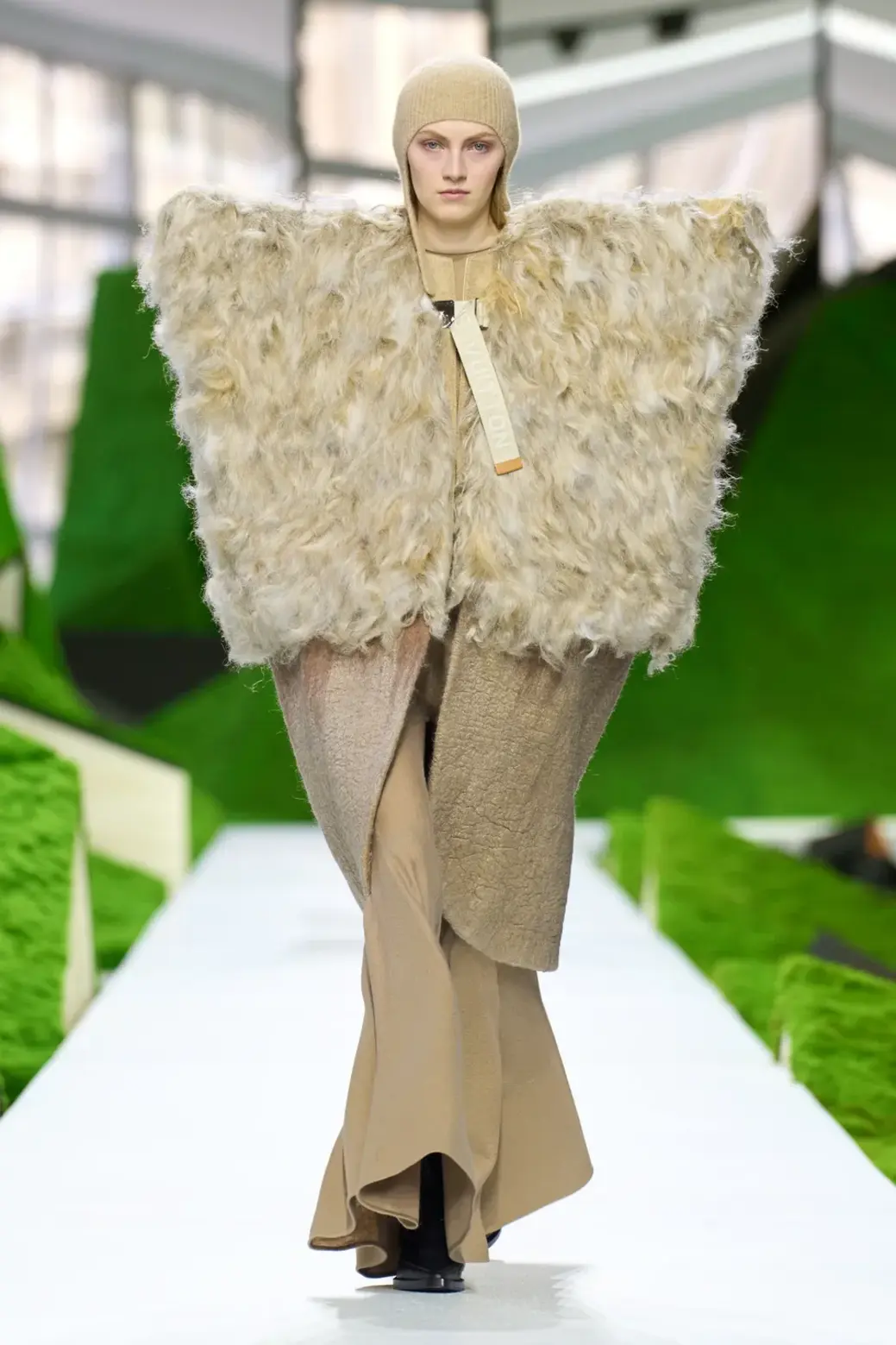
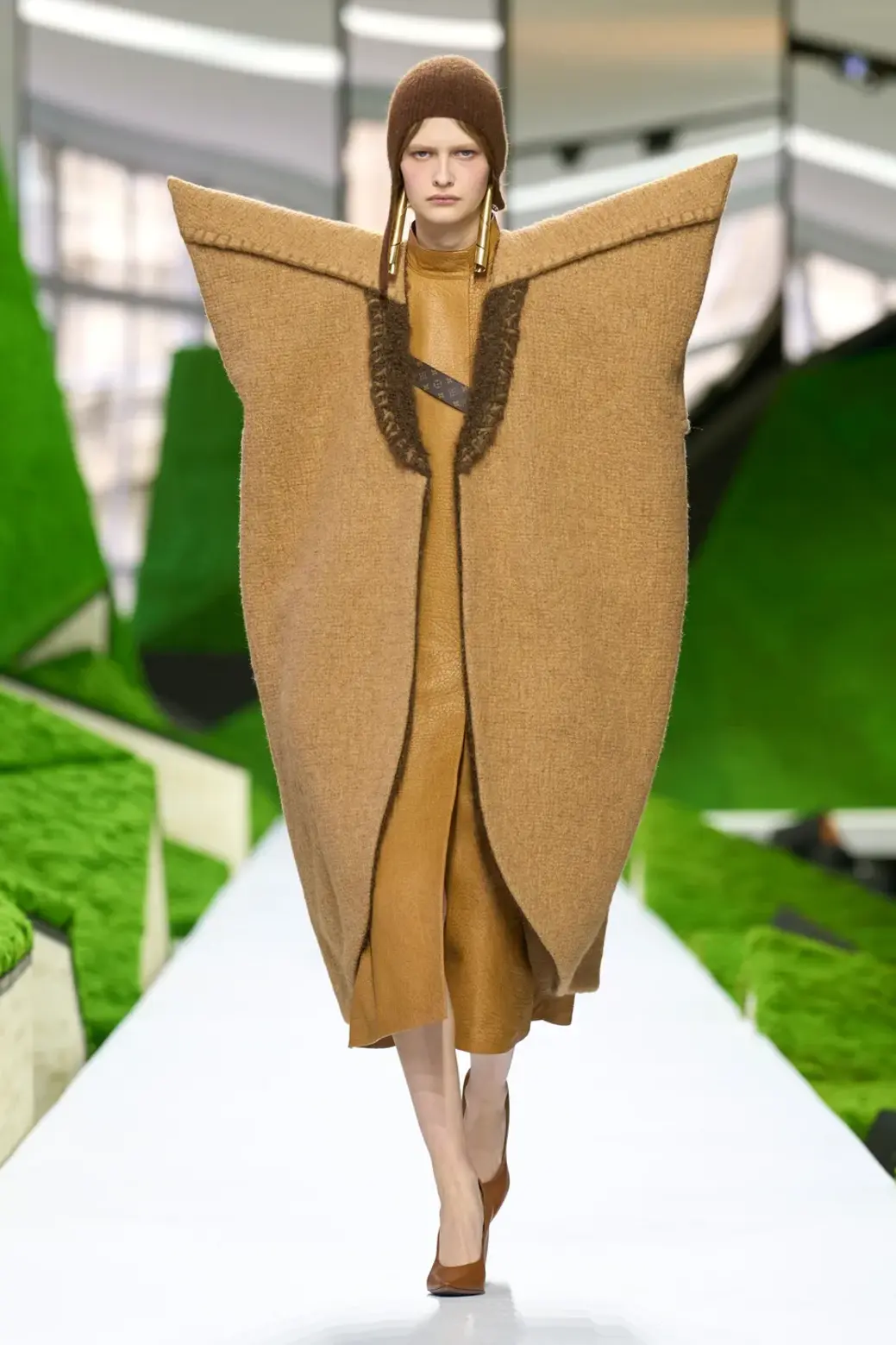
What makes this collection richer than a generic pastoral fantasy is that its geography is plural. Nicolas Ghesquière begins from the Jura, the mountain region tied to Louis Vuitton’s own origin story, then pushes outward into a wider belt of highland and nomadic dress languages: felted shepherd protection, wrapped and padded cold-weather layers, fur yokes, triangular headwear, carrying sticks, bells, wicker, and the practical poetry of clothes made for exposure rather than decoration. That is why the show feels less like one village and more like a caravan of climates. It imagines a woman dressed by altitude, migration, and weather memory, moving between the forests of Peru, the mountain routes of Nepal, and the open cold of the Mongolian steppe without ever becoming a postcard of any one place.
The strongest idea here is that these references are not applied as costume quotation. They are translated through shared survival forms. Across mountain and pastoral cultures, people solve similar problems with clothing: how to wrap the body, shield the shoulders, store what must be carried, protect the head, widen the coat into shelter, or build warmth into trim, felt, fleece, and quilting. Nicolas Ghesquière uses those shared logics as his raw material. He is less interested in reproducing one traditional garment than in capturing the anthropology behind it: the fact that weather leaves similar signatures on dress even across distant places.
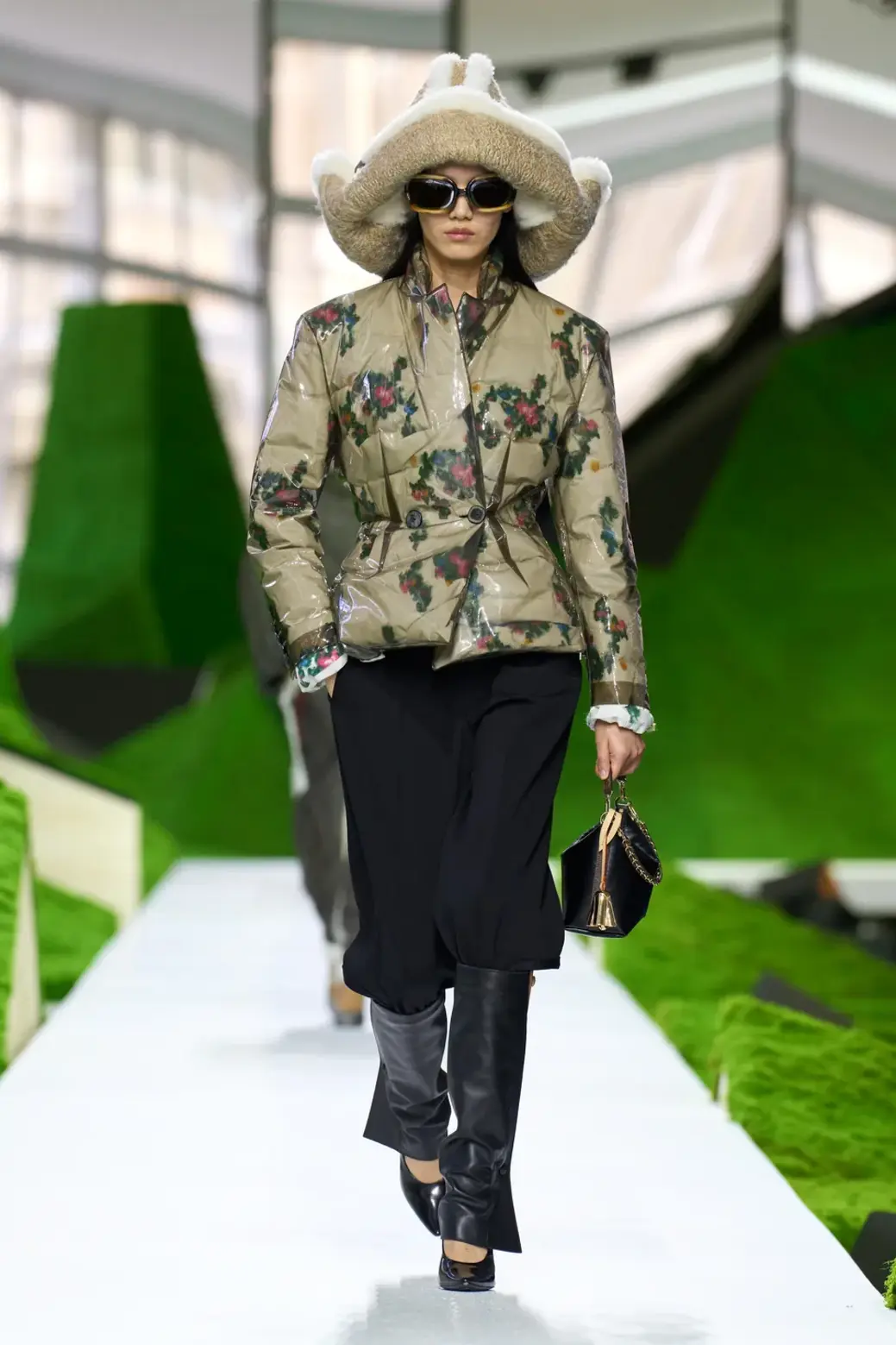
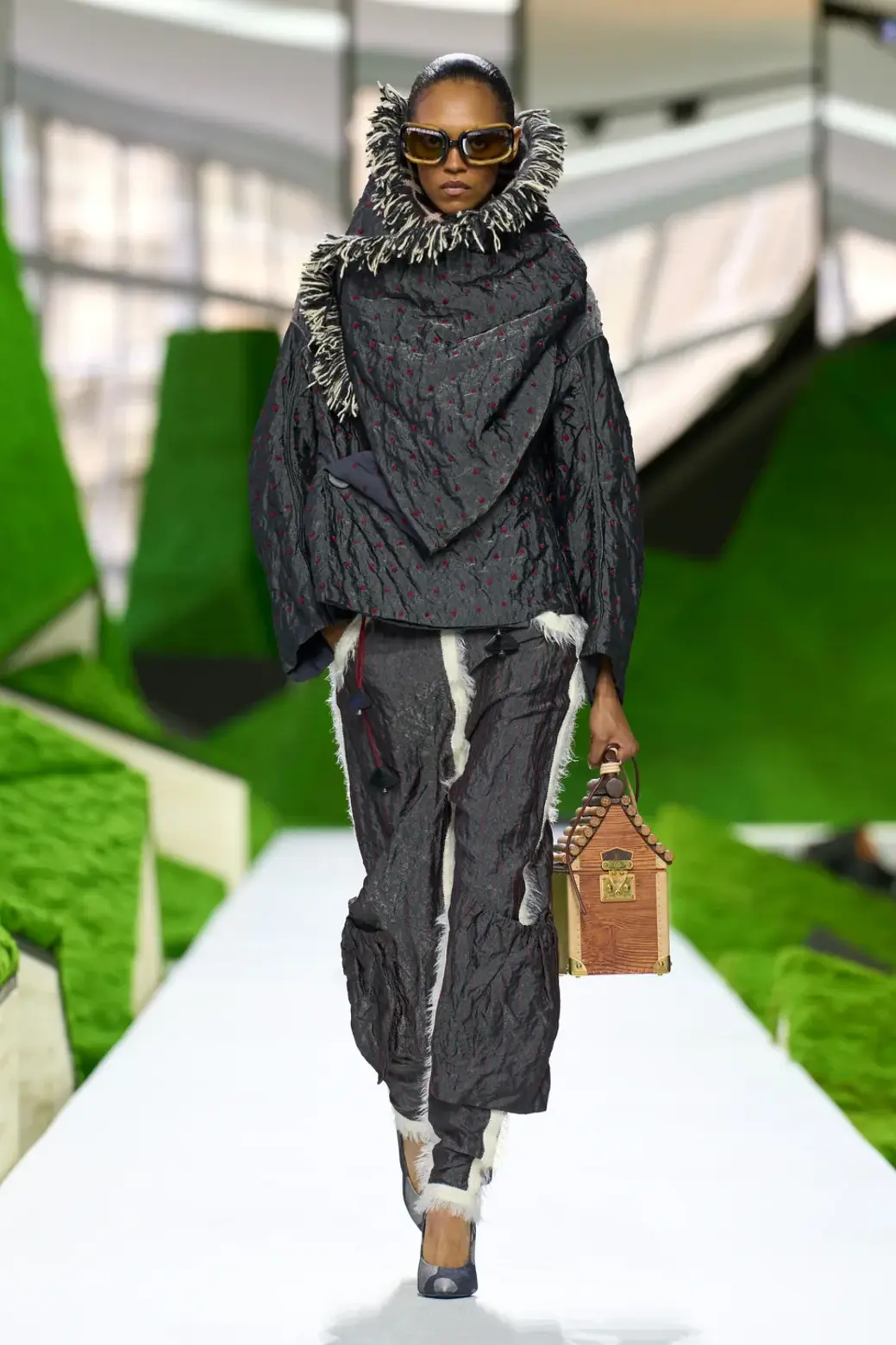
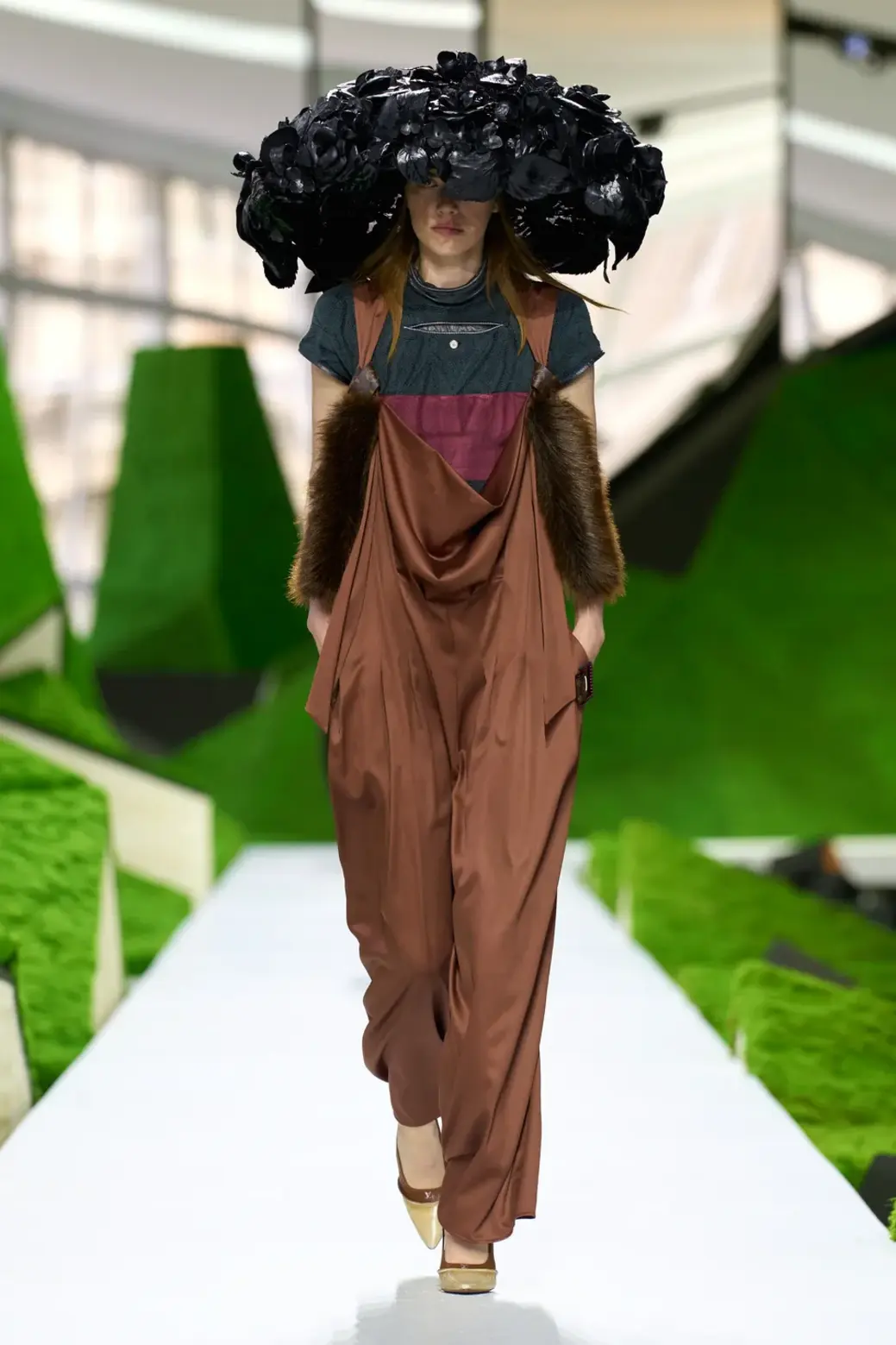
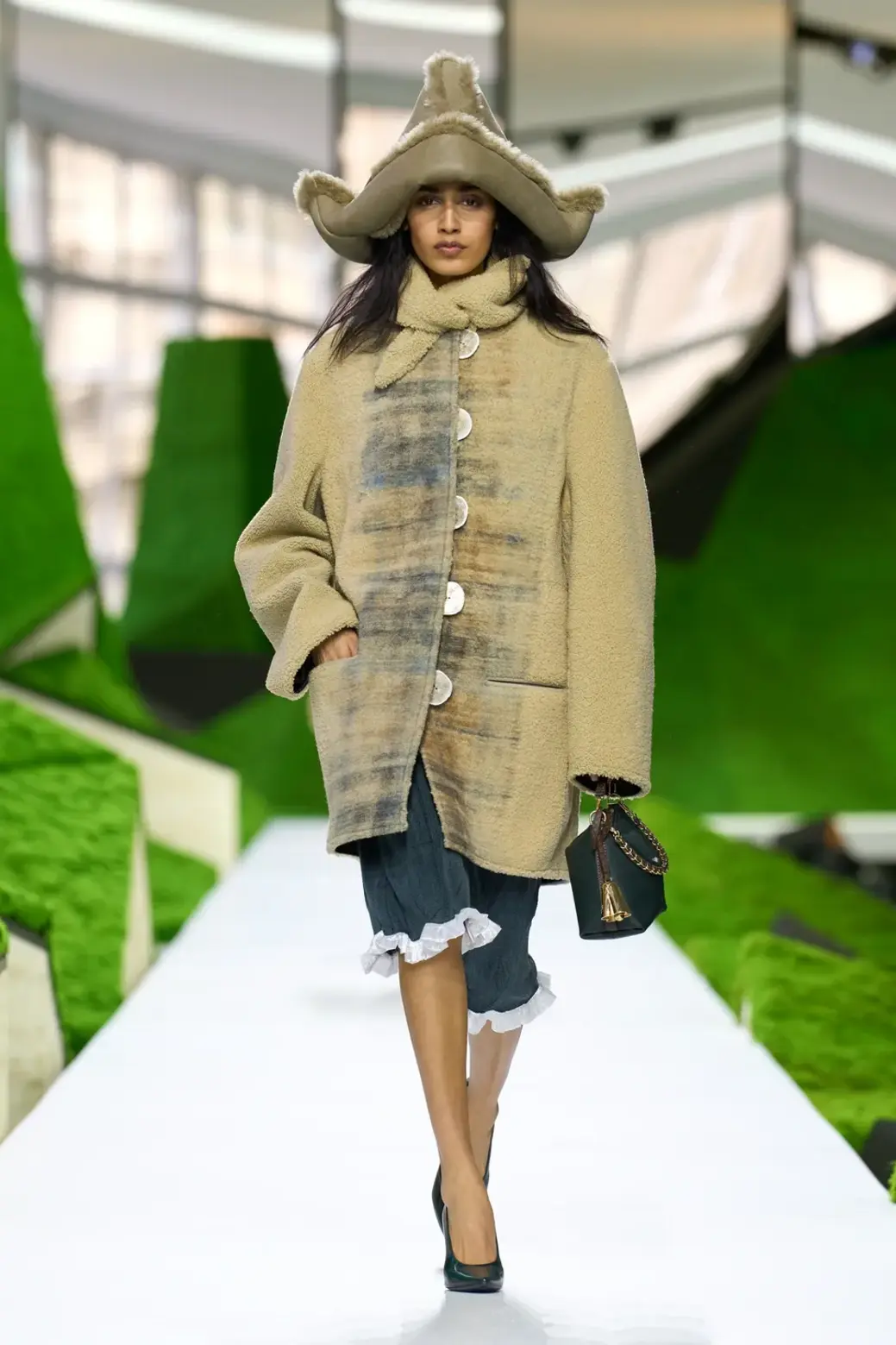
The opening looks matter because they announce that the collection begins in protection, not prettiness. Those giant, tented, high-shouldered coats read as an ode to shepherd outerwear, especially the felted protection garments associated with mountain herding cultures. One strong review explicitly linked them to the Turkish kepenek, a shepherd’s coat built to ward off cold, rain, and even predators. That reference is crucial because it explains why the shoulders feel so dramatic: they are not just fashion exaggeration, they are survival architecture enlarged into myth. In Ghesquière’s hands, the coat stops being merely outerwear and becomes topography. It reads like cliff, shelter, and animal hide at once.
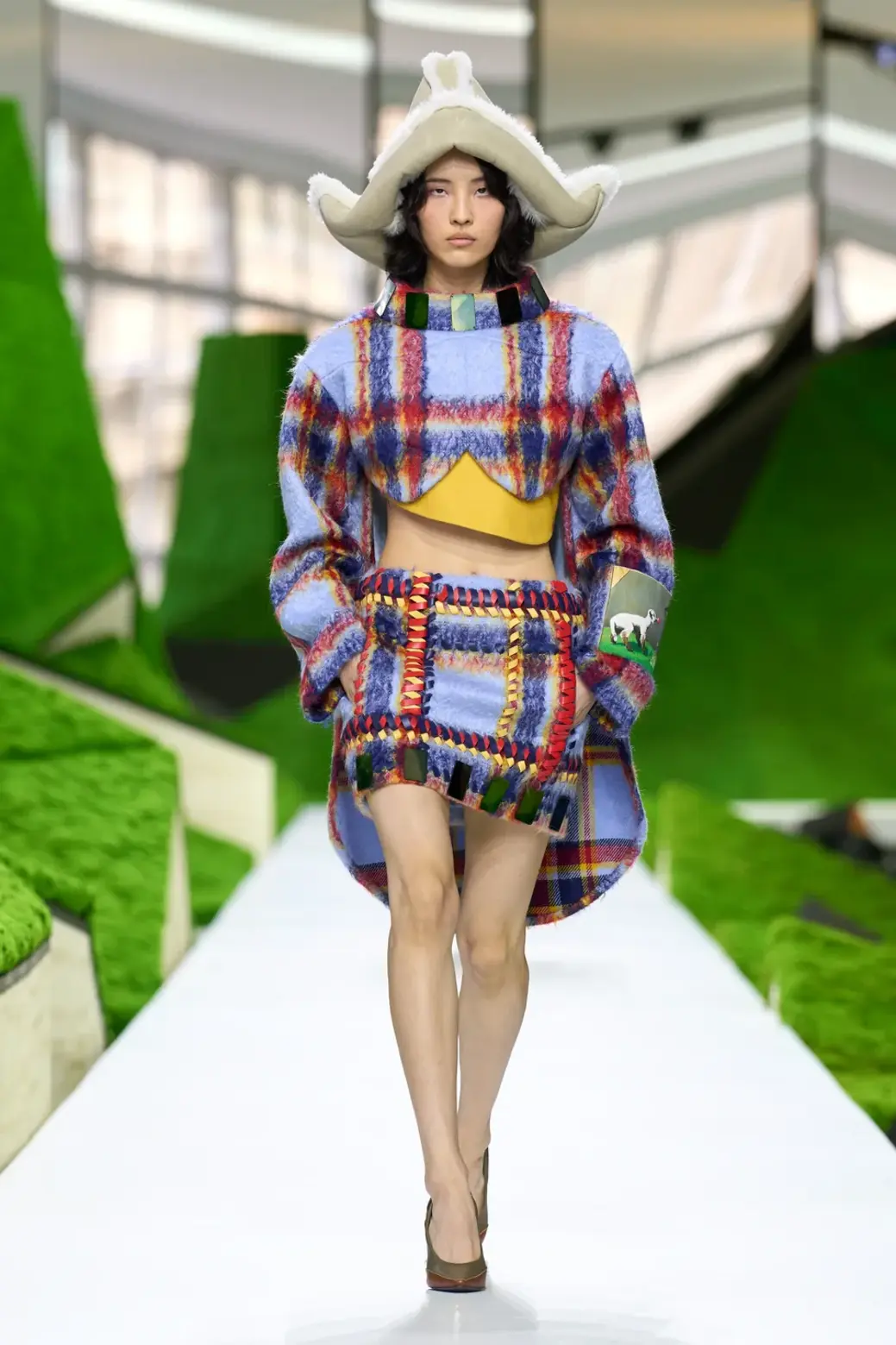
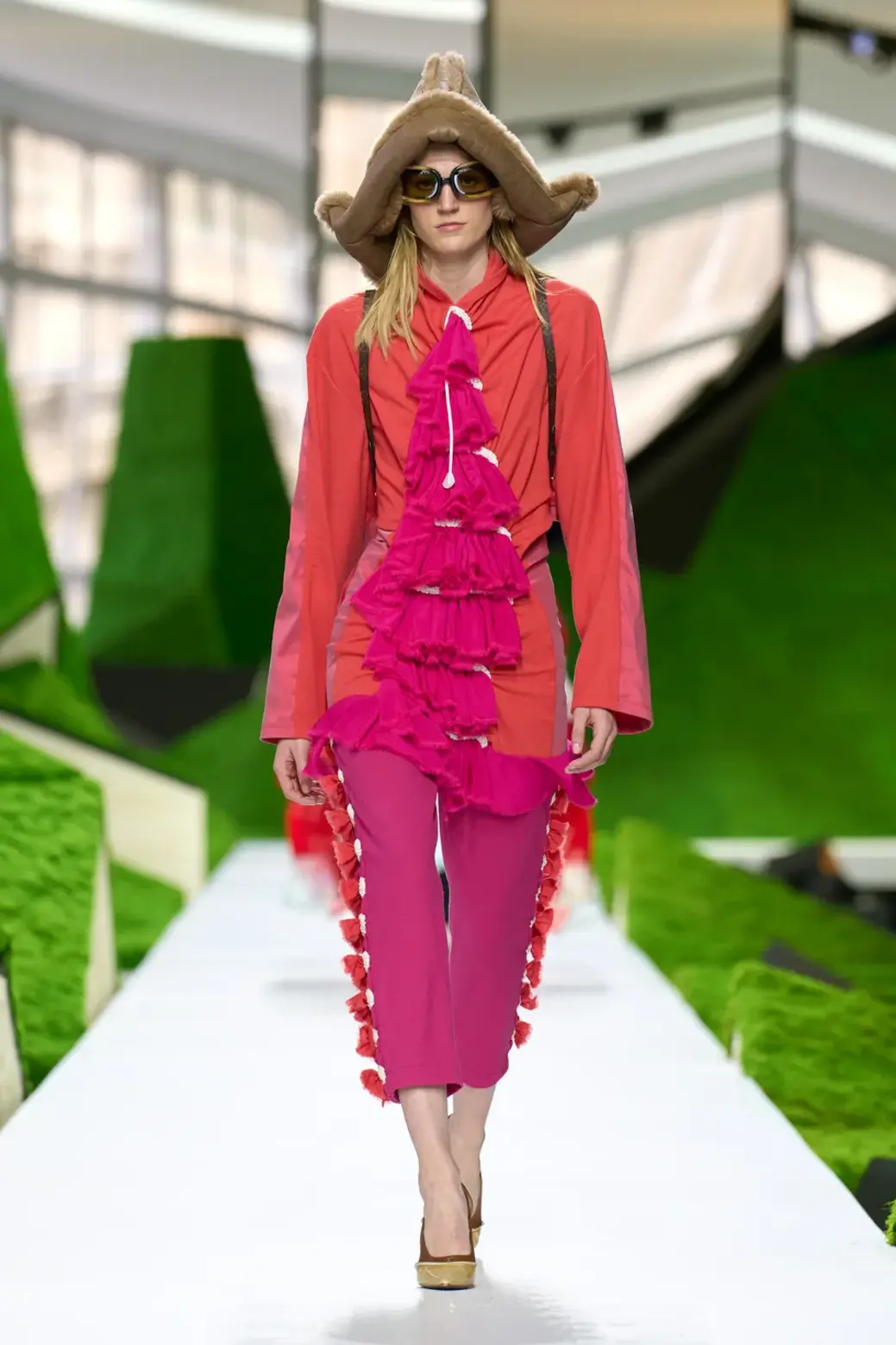
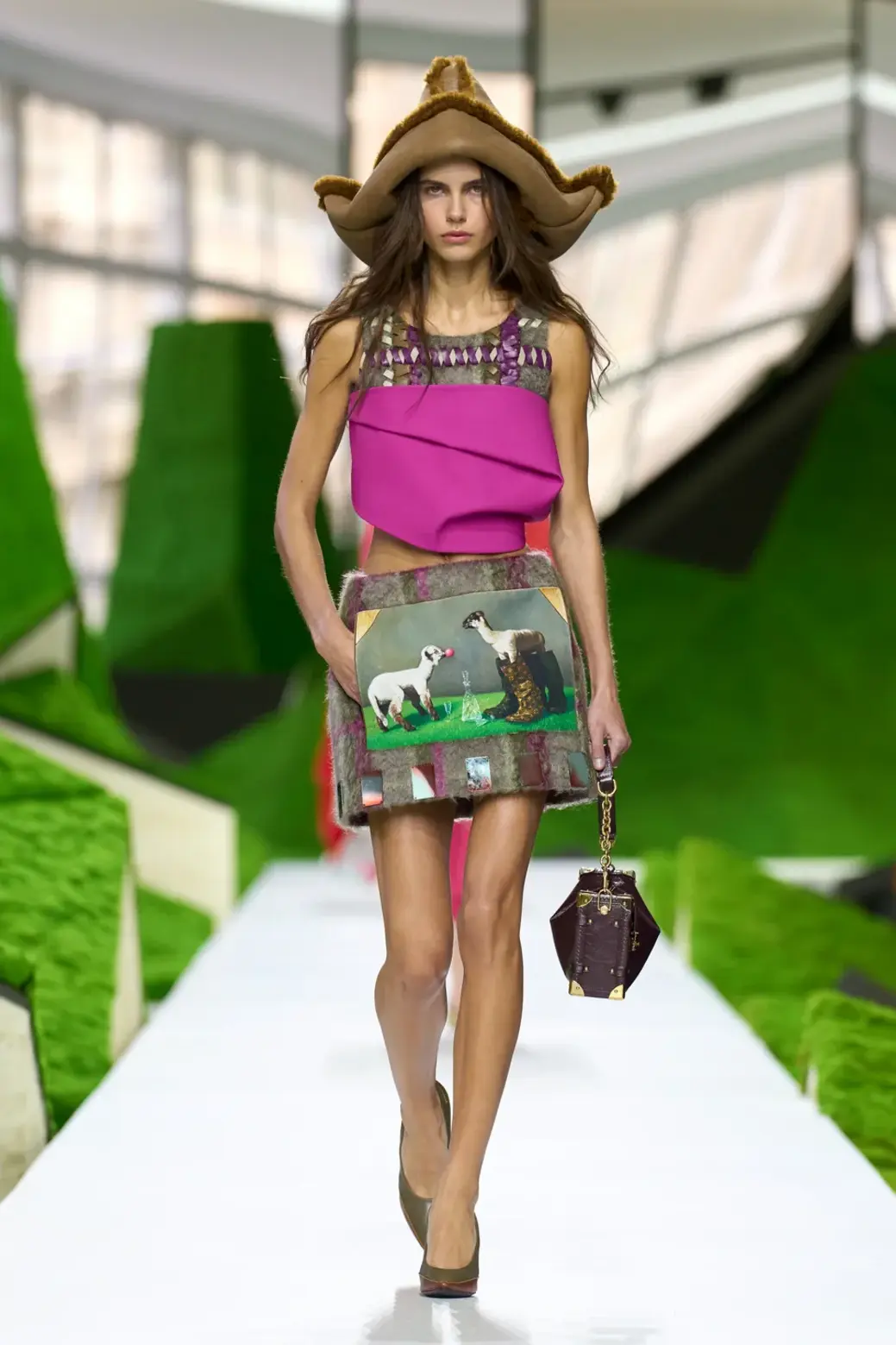
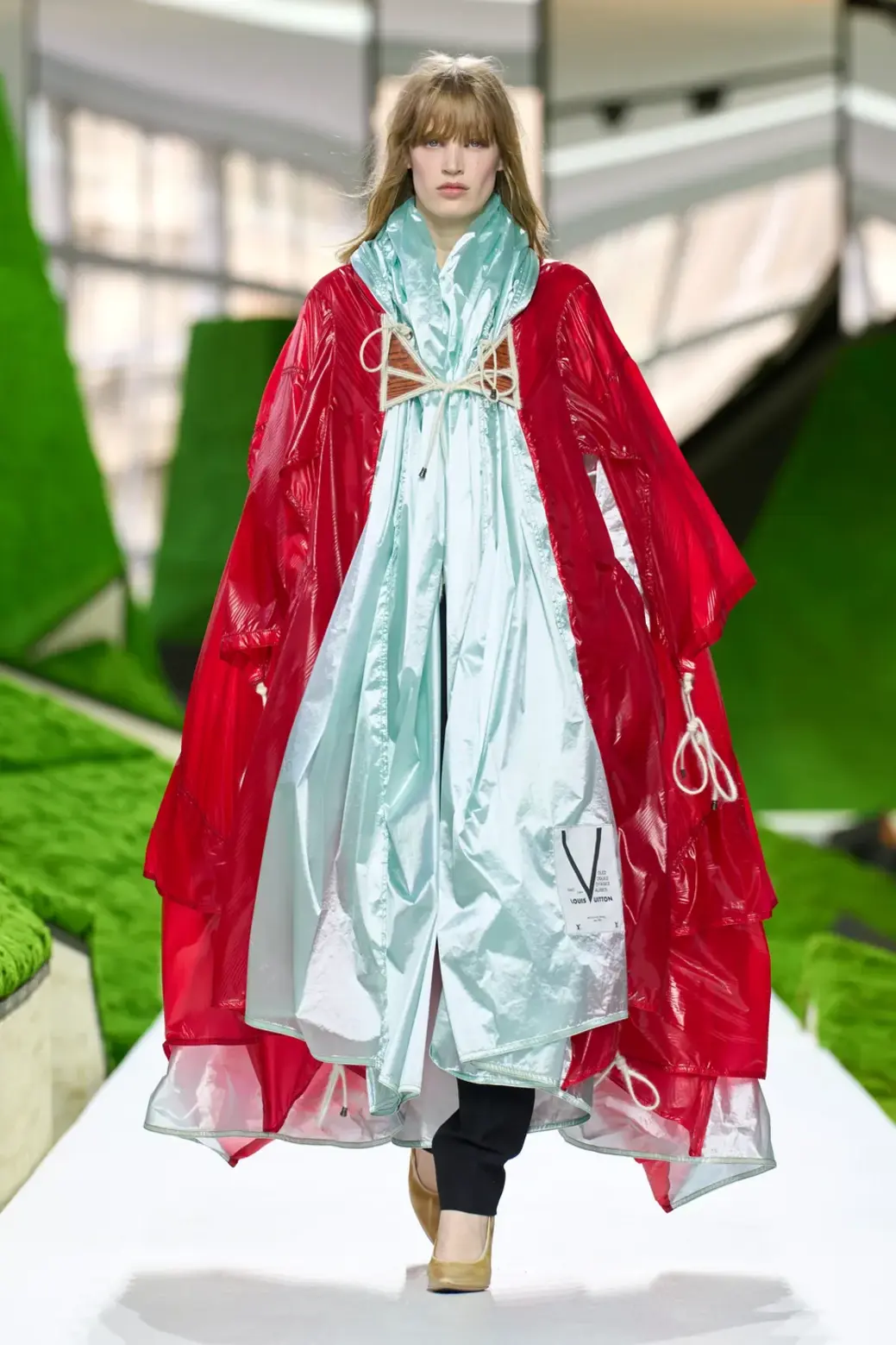
That is also where the show finds its first real atmosphere. These coats do not belong to a salon. They belong to wind. They feel as though they have been stood up against sleet, smoke, pasture frost, and the hard silence of high country. But then Ghesquière distorts them through his own signature language: the line goes too broad, the silhouette too architectural, the shoulder too sheerly designed to remain folkloric. This is his genius. He does not preserve tradition under glass. He lets it mutate until it becomes both ancient and unmistakably his.
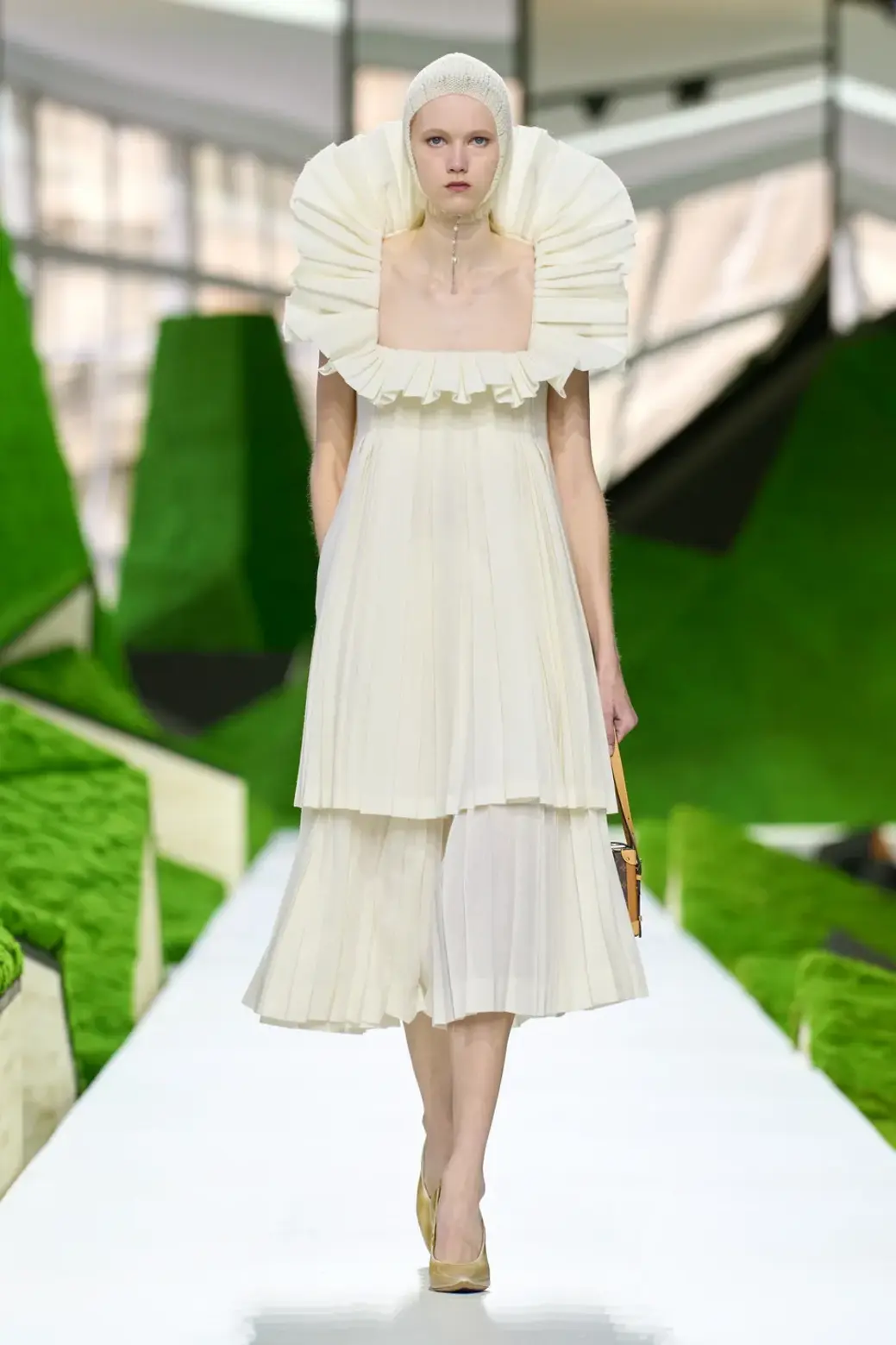
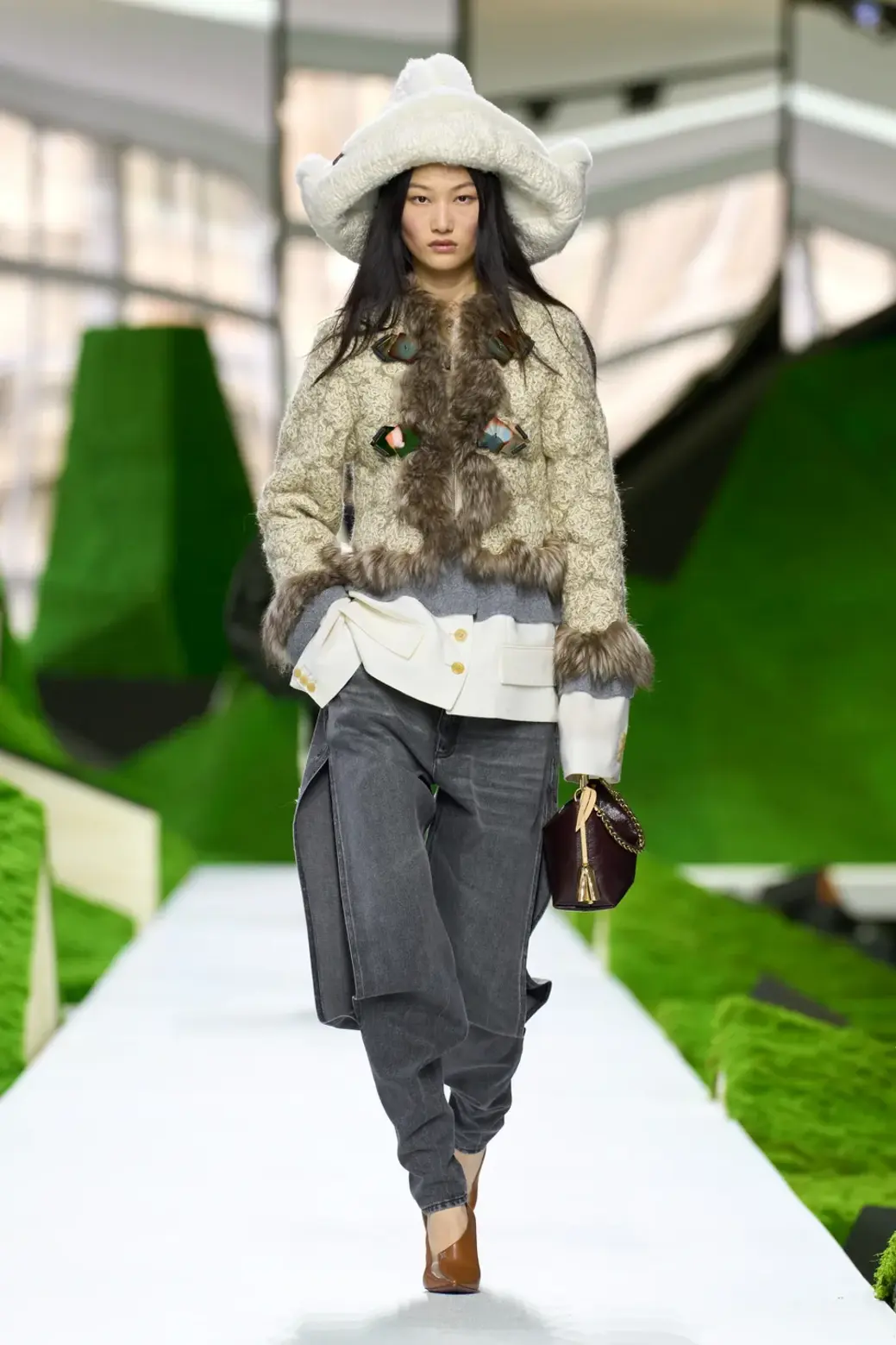
The Nepal reference is not there as a decorative flourish. It shows up in the collection’s love of wrapped, padded, swaddled forms and in those jackets with fringed yarns that one review connected to Sherpa dress. That matters because Sherpa clothing traditions are shaped by altitude, layering, labor, and bodily endurance. In the collection, that logic becomes luxurious without losing its mountain intelligence. Jackets cinch and wrap rather than merely close. Padded outerwear sits close like a portable shelter. Layers pile in a way that suggests lived cold rather than urban styling. This is village craft made cinematic.
Even when the pieces become silky, glossy, or oddly futuristic, the mountain principle remains. Overalls, padded jackets, and cape-windbreakers are not inserted as sportswear detours; they are Nicolas Ghesquière’s way of asking what practical dressing might become in a future folklore. He treats wrapping as both cultural memory and design structure. You can feel the bodily logic underneath the luxury: insulation, swaddling, fastening by hand, moving across open ground. That is why the collection feels immersive. It knows what kind of weather its clothes belong to.
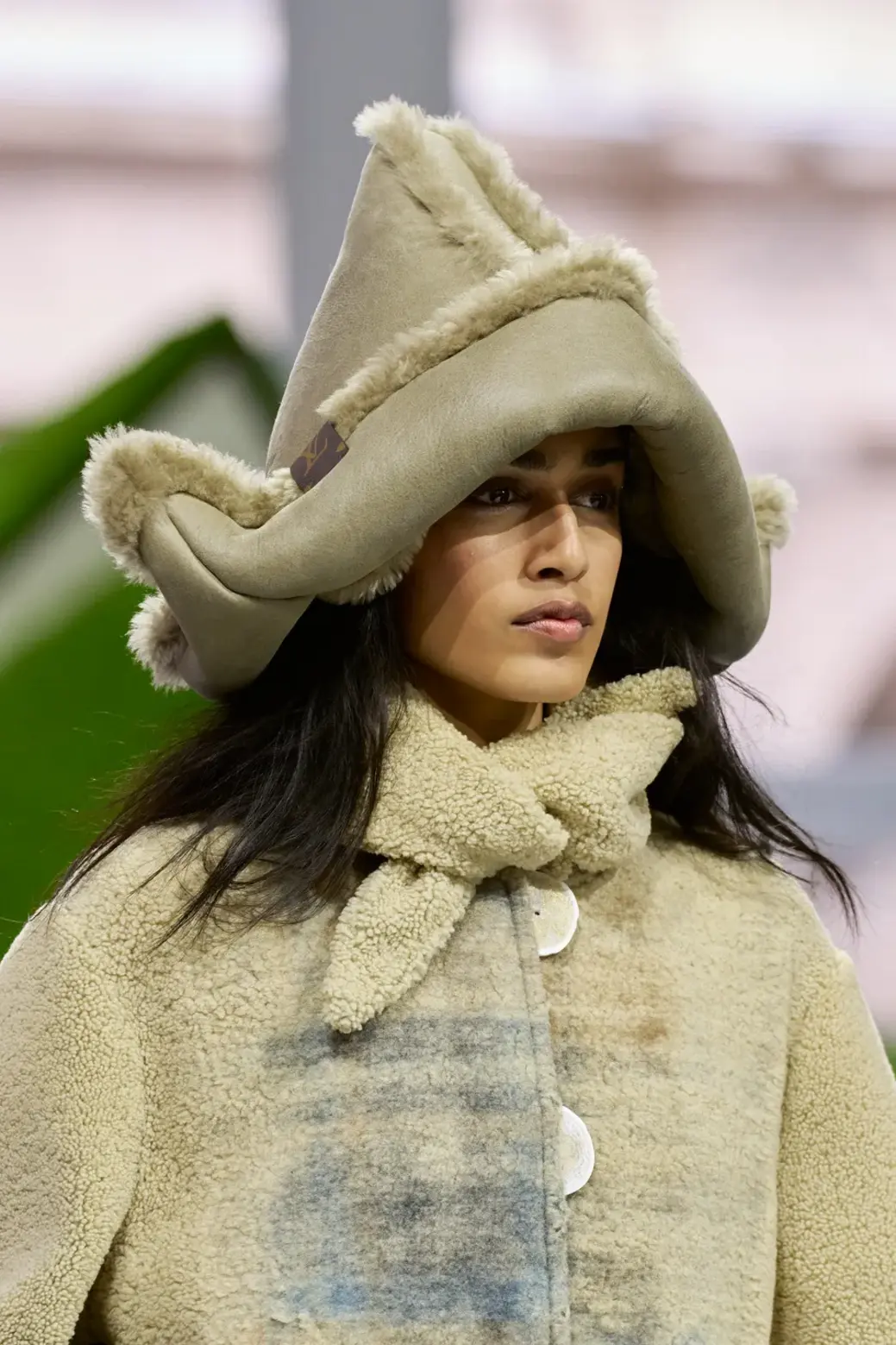
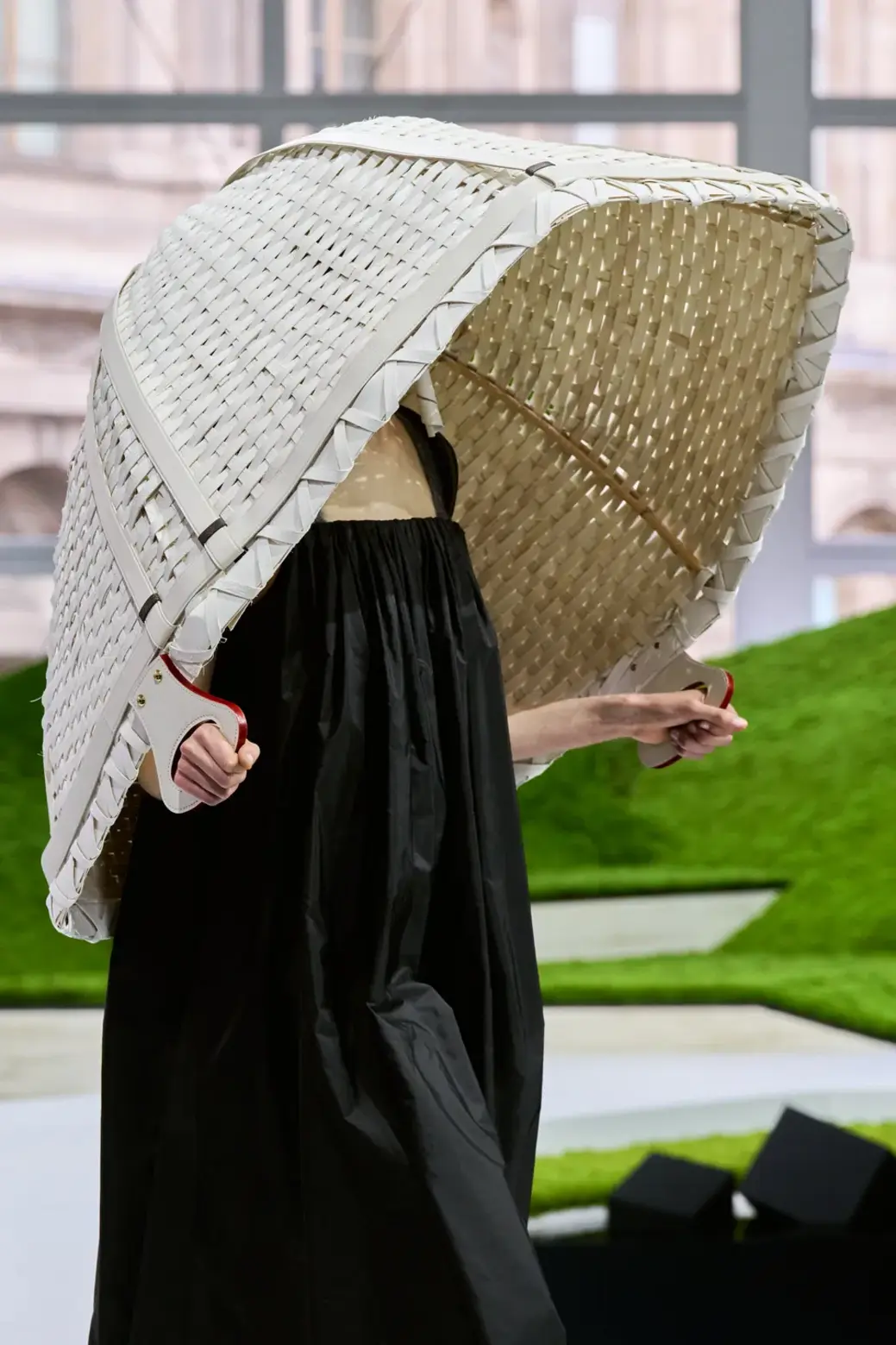
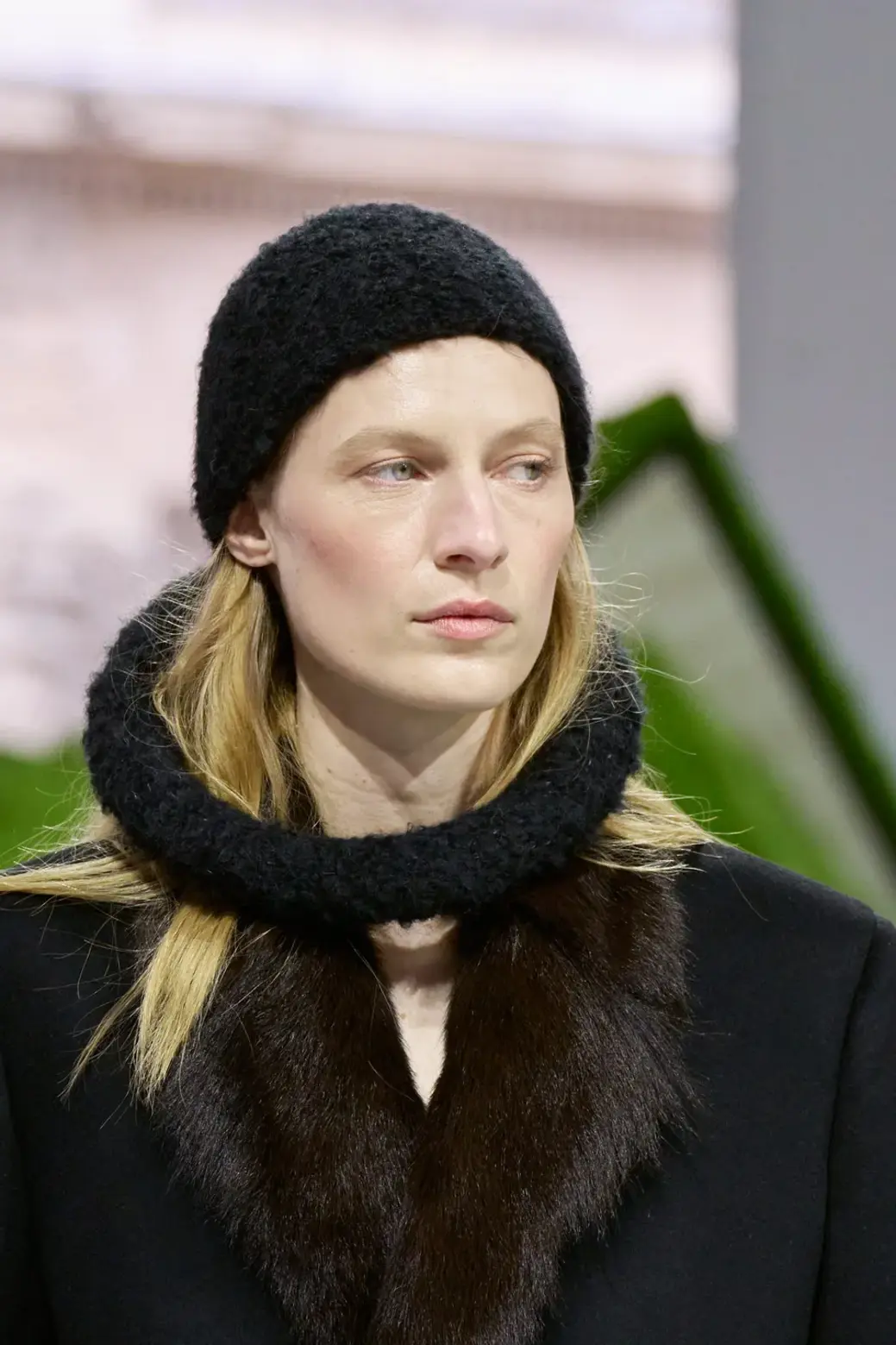
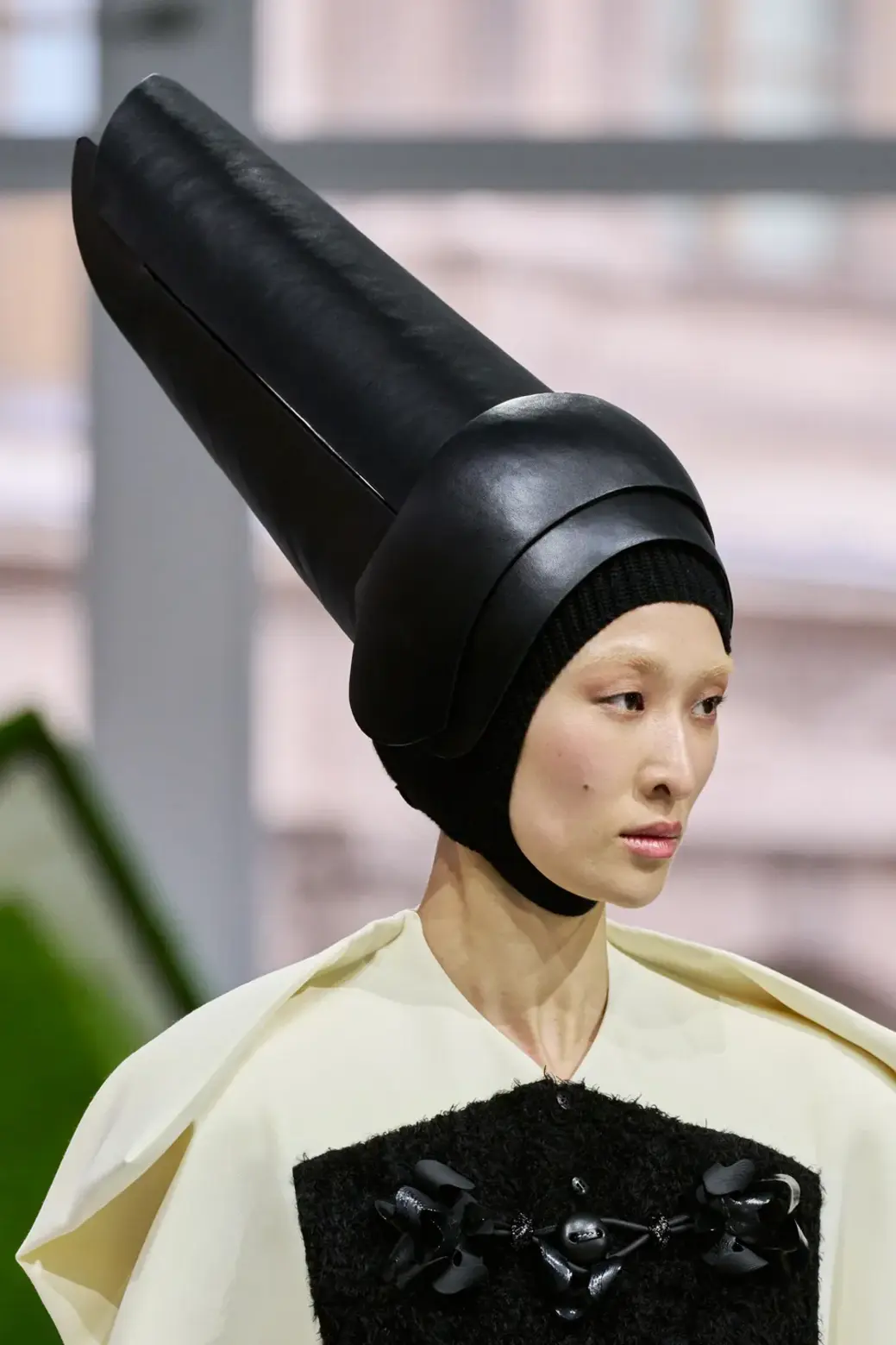
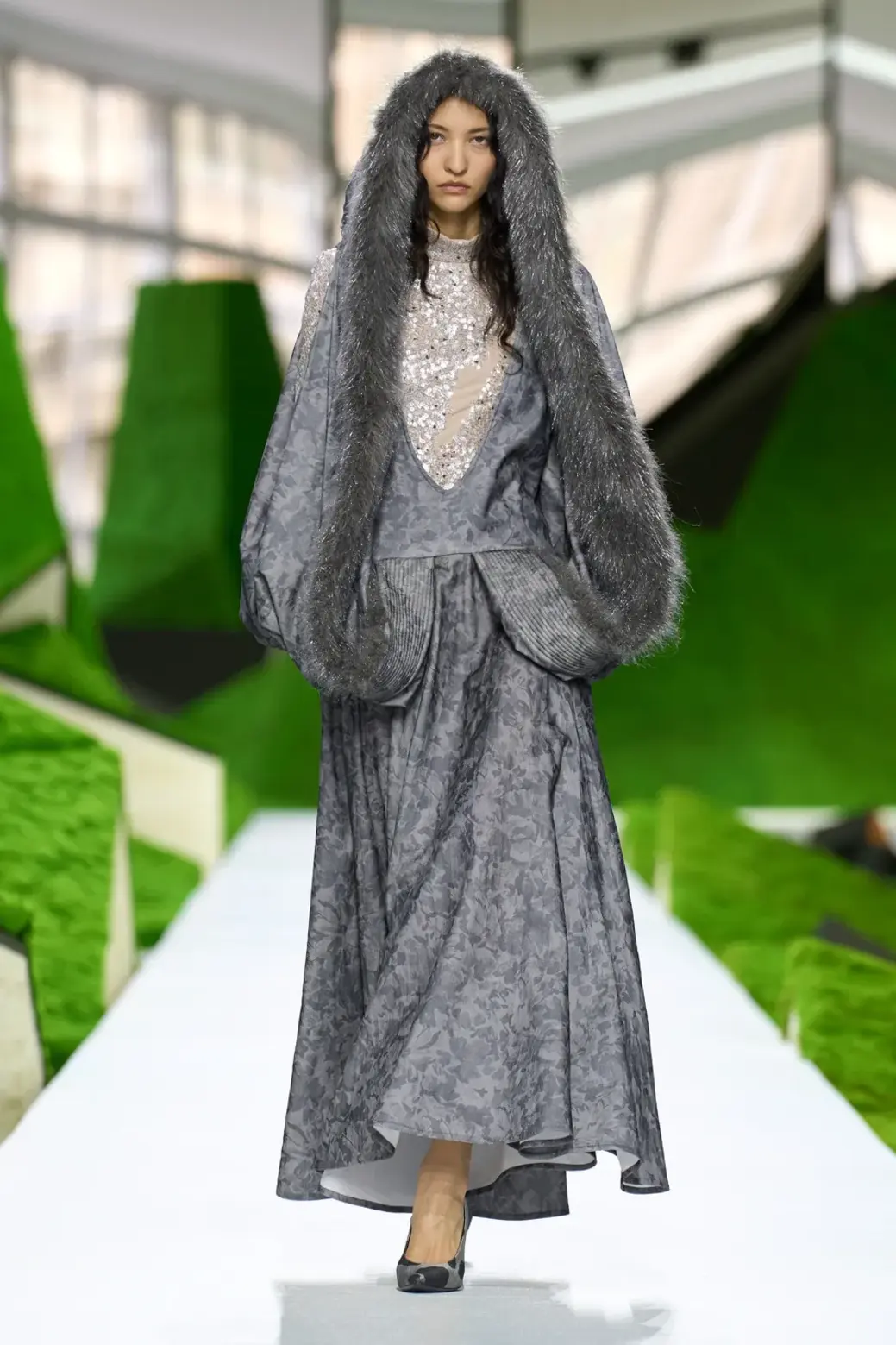
The collection’s dialogue with the steppe is clearest in the fur language and headwear. Reuters noted shearling hats inspired by Central Asia, while other coverage and the detailed review language around the show pointed to Mongolian associations in the fur yokes and triangular silhouettes. These references are persuasive because they sit in the most visible zones of the body: the crown, the shoulder, the upper back. In nomadic and steppe dress, those zones are often where identity, weather protection, and ceremonial silhouette meet. Nicolas Ghesquière seizes exactly those points. He builds hats that rise like signals and shoulders that look as if they were bred for horizon wind.
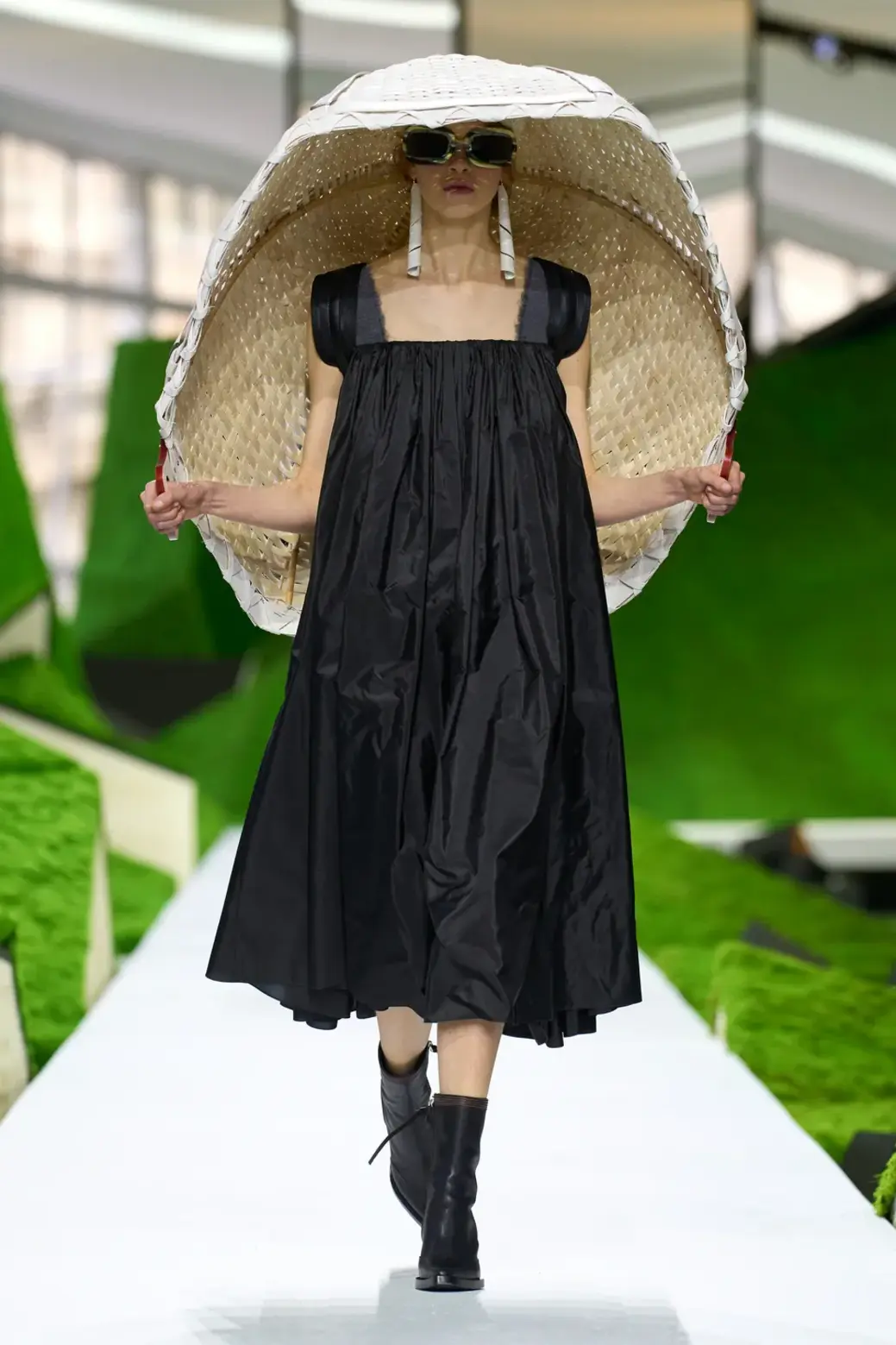
This is why the headwear is so important. It is not merely surreal styling. It is the part of the collection that most clearly tells you these women live outside. Basket-like hats, conical pieces, triangular forms, quilted cone hats, and shearling shapes all suggest different relationships to climate, labor, and ritual. Some read like practical shields. Others look ceremonial, almost tribal in the old sense of belonging to a community and a terrain. But Nicolas Ghesquière always pushes them one step away from realism. He lets them hover between village memory and science-fiction headgear, which is precisely how the whole collection operates.
The Peruvian feeling enters less through one literal garment than through surface, pastoral image, and textile warmth. Critics saw Peru in the checks, the woven-looking layers, the hand-touched patchwork, the lamb imagery, and the broader sense of rural dress abstracted into bold graphic planes. Nazar Strelyaev-Nazarko’s sheep paintings, placed on skirts and patch details, are essential here. They stop the collection from becoming a purely theoretical exercise and return it to flock, field, and creature. Those little lambs are not trivial. They are the emotional hinge between folklore and fashion system, between shepherd life and runway spectacle.
And because Nicolas Ghesquière is too strange a designer to let that pastoral image sit quietly, he counterbalances it with harder design choices: bloomered hems, fur-trimmed seams, mirrored panels, built-in corsets, and coats that sit almost flat and then suddenly explode at the sleeve or shoulder. So the rural reference never becomes soft handicraft. It remains under tension. It says handwork, flock, pasture, plaid, yes, but always through the pressure of a designer who loves structure more than nostalgia.
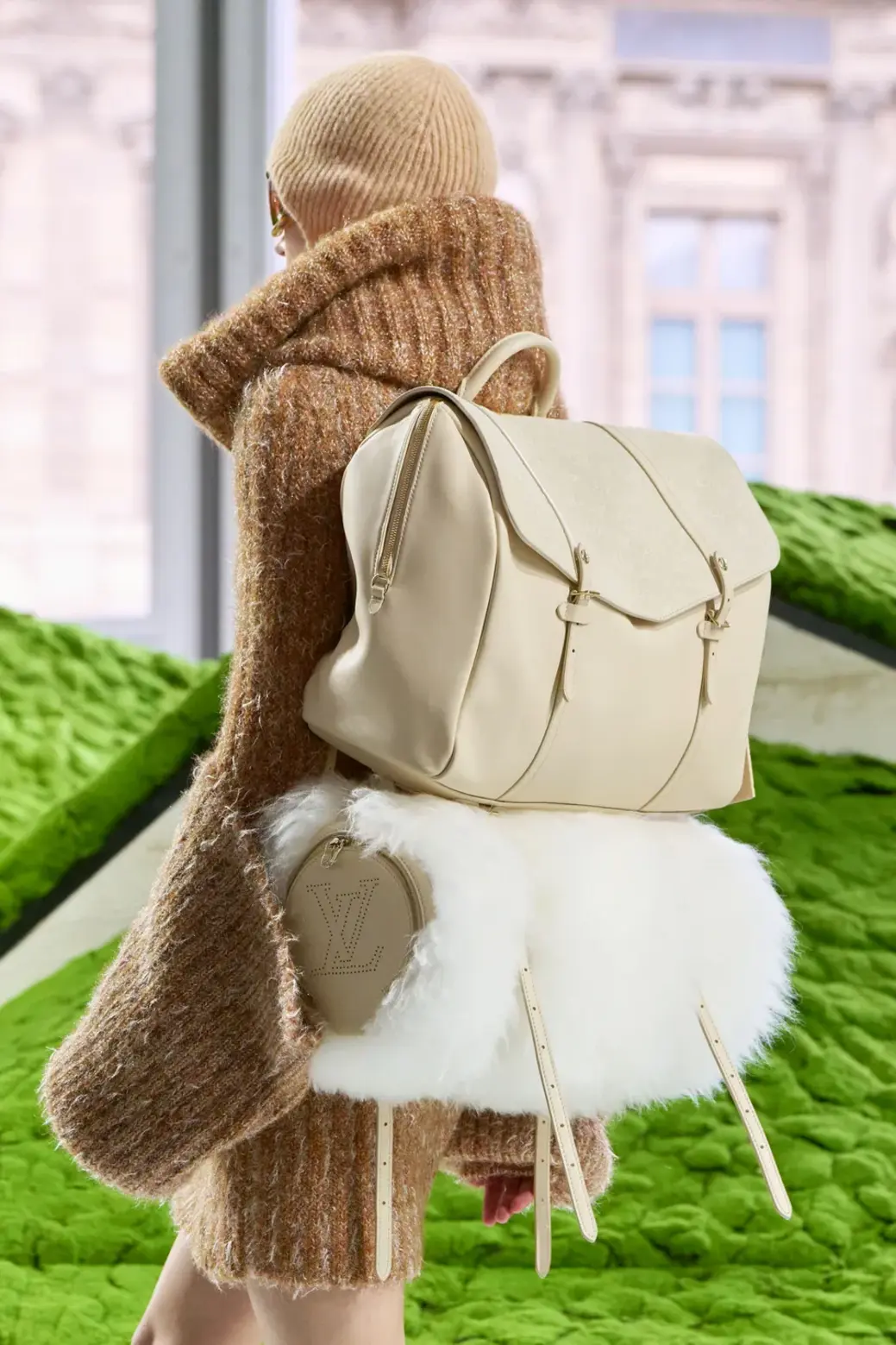
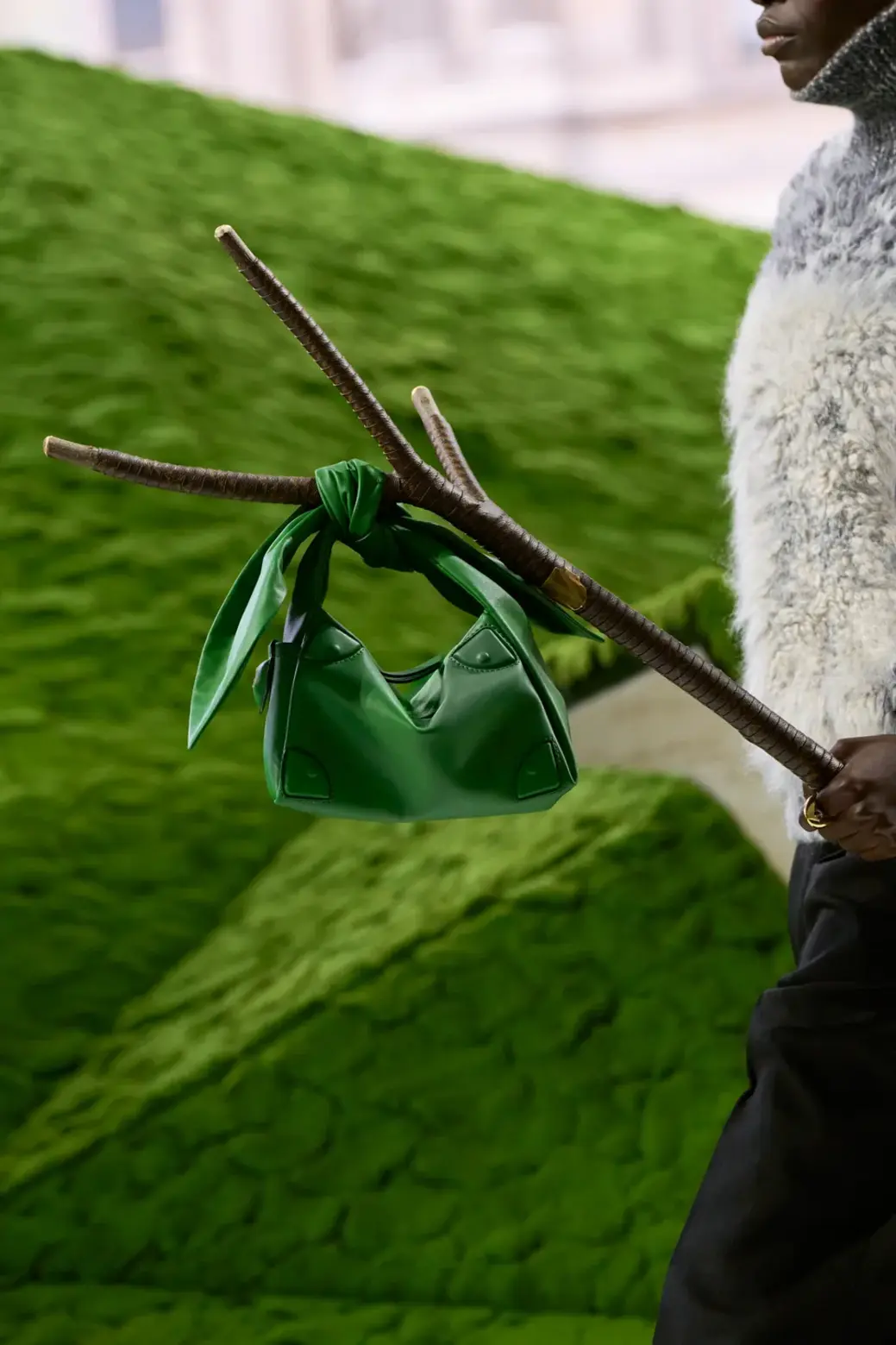

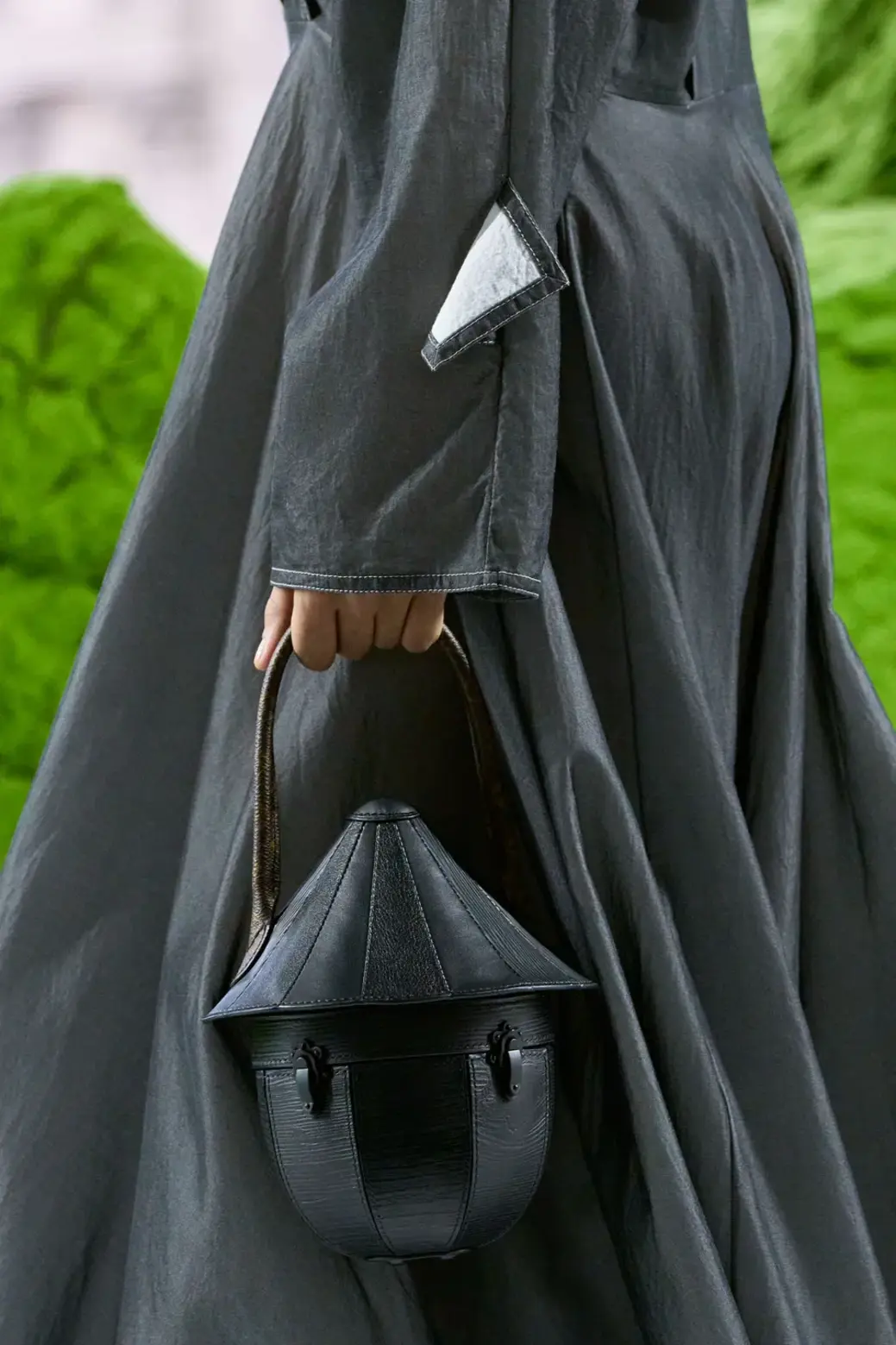
The most beautiful detail in the entire collection may be the decision to turn accessories into tools of passage. One model carried a soft leather bag tied to a stick like a traveler’s bundle. Another carried a cow bell. The Noé returned not as city heritage piece but as something adapted to a nomadic route. These gestures matter because they rewrite Louis Vuitton’s travel mythology from station platform to mountain path. The house of trunks and steamer luggage suddenly remembers pack routes, herders, and hand-carried essentials. Travel becomes roughened, improvised, and far more alive.
That shift is what gives the collection its local soul. The bag on the stick is a mountain-born image of mobility. The bell brings in livestock, flock movement, and the soundscape of pasture life. Even the baskets and antler heels make more sense inside that same world: they belong to a woman who measures distance differently, who is closer to terrain and season than to city asphalt. Nicolas Ghesquière makes luxury accessories answer to weather and livestock, and that is exactly why they feel so fresh.
The cultural richness of Louis Vuitton Fall 2026 lies in the fact that Nicolas Ghesquière extracts the structural intelligence of land-based dress: sheltering shoulders, padded wraps, fur at the body’s exposed edges, hats as weather devices, woven checks, carrying tools, bells, sticks, felted volume, nomadic storage, and silhouettes shaped by wind rather than by drawing-room manners. Then he pushes all of that through his own severe proportion games until it becomes future folklore instead of reenactment. That is why the collection feels immersive. It does not just reference the mountain. It behaves as though it has lived there.
Louis Vuitton Fall 2026 by Nicolas Ghesquière feels so powerful because it treats folklore not as nostalgia, but as a future tense, a way of carrying the mountain, the pasture, the steppe, and the handmade memory of survival into a world that has almost forgotten how clothes were first asked to matter.
Advertisement