MENU
Close





Boucheron Human Being, Claire Choisne’s July 2026 Carte Blanche collection, pushes high jewelry away from the usual obsession with carat weight and gemstone hierarchy.
Boucheron Human Being, Claire Choisne’s July 2026 Carte Blanche collection, pushes high jewelry away from the usual obsession with carat weight and gemstone hierarchy.
July 14, 2026


Claire Choisne has always been fascinated by the fleeting charm of life. After her 2025 Impermanence collection, the beauty of the moment is again captured in Boucheron's July 2026 Carte Blanche: Human Being. In an era obsessed with teaching machines to imitate humans, Boucheron chooses a more difficult path: blowing the human soul into stones.
High jewelry has always depended on a paradox. Its materials may be millions of years old, yet their value is finalized in the fleeting decisions of living people: a cutter judging a fraction of light, a setter adjusting pressure by instinct, an engraver changing direction before a stone resists. For Boucheron’s Carte Blanche 2026 collection, Claire Choisne makes that paradox the subject rather than leaving it hidden inside the workshop.
Titled Human Being, the collection repeats one archetypal form—the cluster necklace—across five parures, each consisting of a necklace and ring. From a distance, their shared structure suggests a common anatomy. Up close, their materials, surfaces and techniques separate into radically different identities. Choisne has framed the project around what connects people beyond difference while preserving the richness of individuality: one visual foundation, five distinct lives.
That restraint gives the idea its force. Carte Blanche has often allowed Choisne to push Boucheron beyond conventional preciousness through unexpected substances, optical illusions and techniques borrowed from other disciplines. Here, novelty is tested against repetition. By holding the silhouette constant, every technical and emotional difference becomes more visible. The collection reads less like a parade of objects than a controlled experiment in singularity.
Boucheron records 1,550 hours for Rain, 3,290 for Flower, 3,750 for Light, 3,740 for Tattoo and 1,990 for Checkers: 14,320 hours across the five sets. Yet Human Being refuses to treat time as a production statistic. Time becomes a material in its own right, accumulated through concentration, correction, invention and judgment.
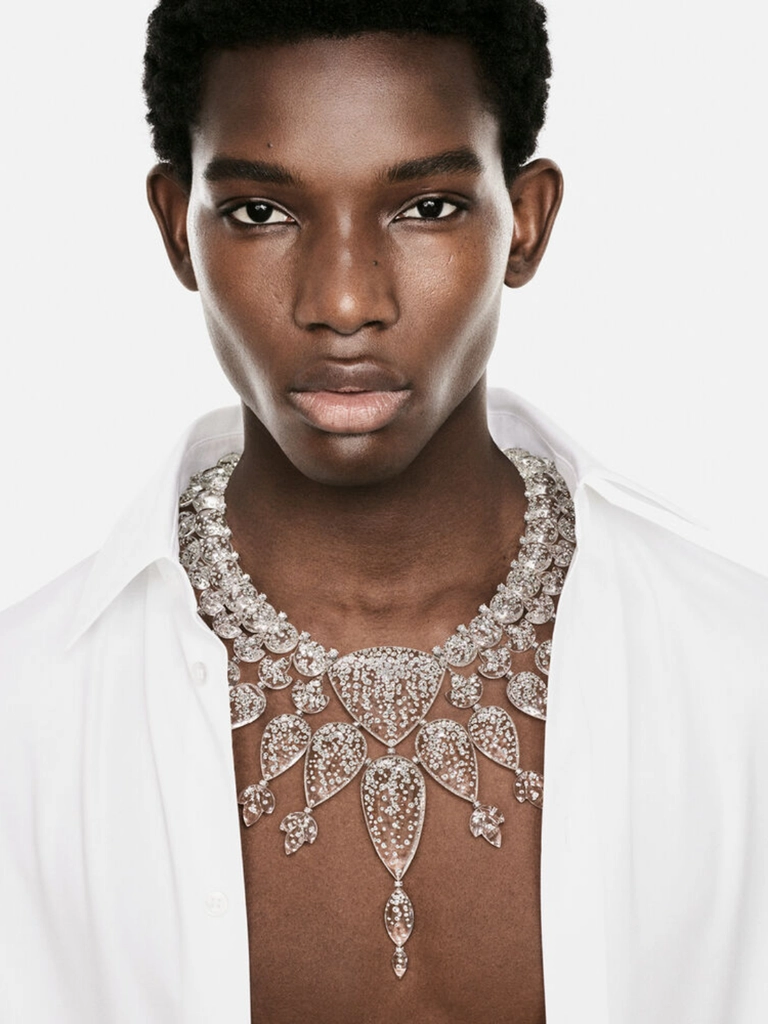
Rain begins with the desire to recreate the breathtaking sensation of a downpour of diamonds frozen in mid-air against the skin.
More than 4,800 stones are suspended inside hollow rock-crystal droplets, where successive layers of plant-based resin were poured under vacuum. The diamonds were positioned by hand in a precise sequence to create depth while preventing bubbles or particles from disturbing the transparency. Metal recedes, gravity appears interrupted and the necklace becomes a downpour arrested just as it reaches the body.
Its achievement lies in controlled irregularity. A perfectly even arrangement would feel mechanical; genuine randomness could dissolve into noise. The artisans had to compose accident. Their labor becomes most convincing where it disappears, inside droplets that seem to have formed without human interference.
Flower takes the opposite route. Where Rain hides the hand to imitate weather, Flower magnifies it through ornament. Its 1,532 carats of rose quartz carry a botanical motif inspired by patterned wallpaper, tracing flowers from tender buds to fully opened blooms. A specialist in micro-miniature painting worked stone by stone under magnification, using tiny shifts of shadow and light to create depth before the work was sealed beneath a matte finish.
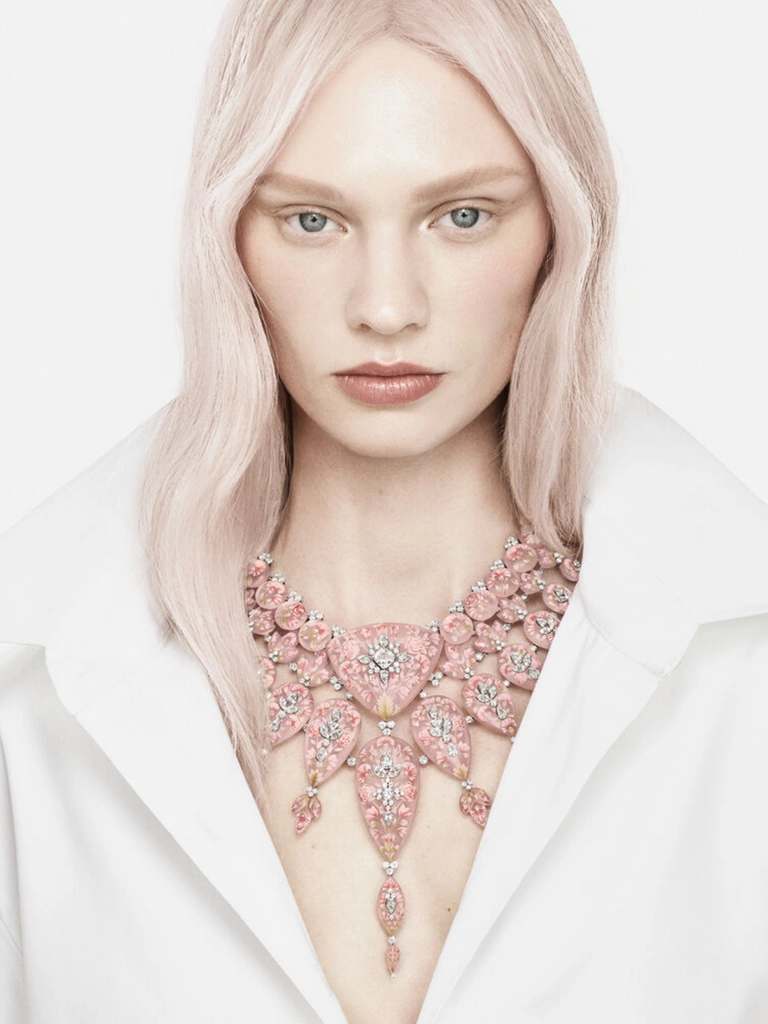
The quartz remains materially hard, yet the painting makes it feel soft, tactile and almost textile-like. To avoid visible prongs breaking the image, each stone was pierced and mounted onto a pin framework, with the supporting structure visually absorbed into the pink composition. A 3.26-carat cushion-cut diamond anchors the necklace without monopolizing it. Flower quietly dismantles the usual hierarchy in which the largest stone dictates a jewel’s value. Here, the microscopic labor of painting becomes equally precious.
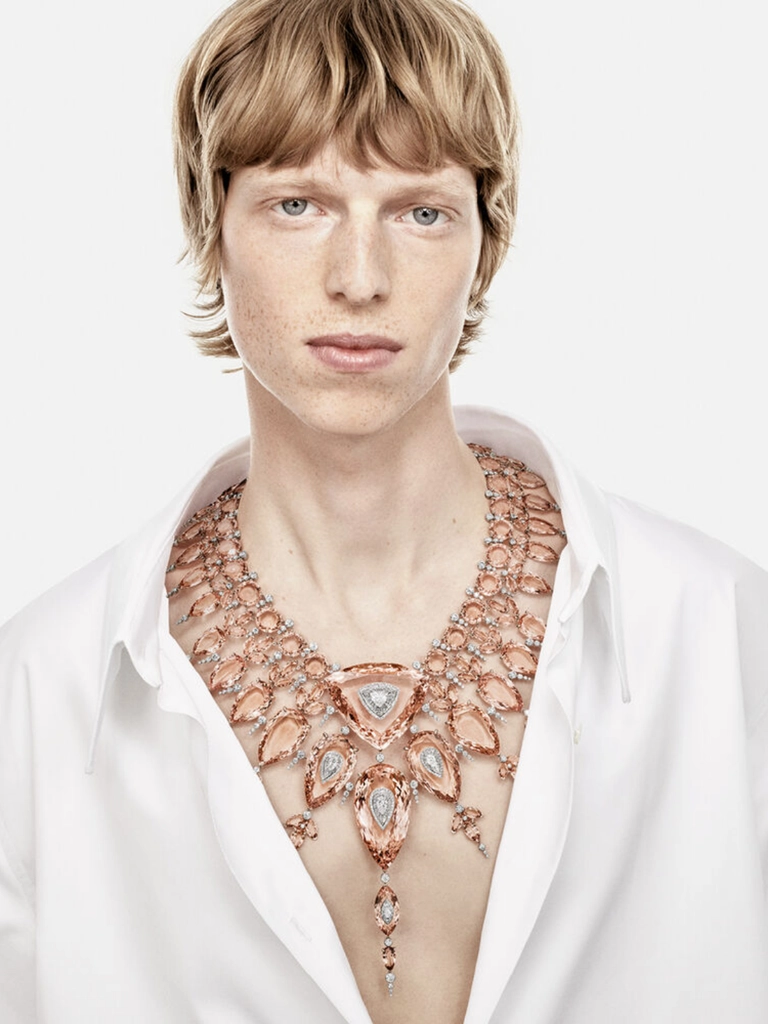
Light offers the collection’s clearest union of beauty and engineering. More than 1,500 carats of morganite were matched for an unusually consistent peach-pink intensity, producing a field through which luminosity appears to circulate without interruption. The stones change in size and position, yet their color behaves like a single atmosphere.
Morganite’s relative delicacy made the mounting a central problem. Traditional hammer-setting risked placing damaging pressure on the material, so Boucheron’s jewelers fitted and screwed rose-gold prongs around each stone. Some morganites were then hollowed to receive concealed frameworks carrying diamonds, creating the impression that white light has emerged from within the colored mineral itself.
This is where Human Being becomes more nuanced than a sentimental defense of tradition. The collection uses vacuum processes, CAD modeling, precision lasers and specialized engineering without anxiety. Choisne has acknowledged both her fascination with and concern about artificial intelligence, while insisting that technology remains limited without craftsmanship, time and human sensitivity. Light embodies that position. Innovation does not replace the artisan; it expands the range of problems the artisan can solve.
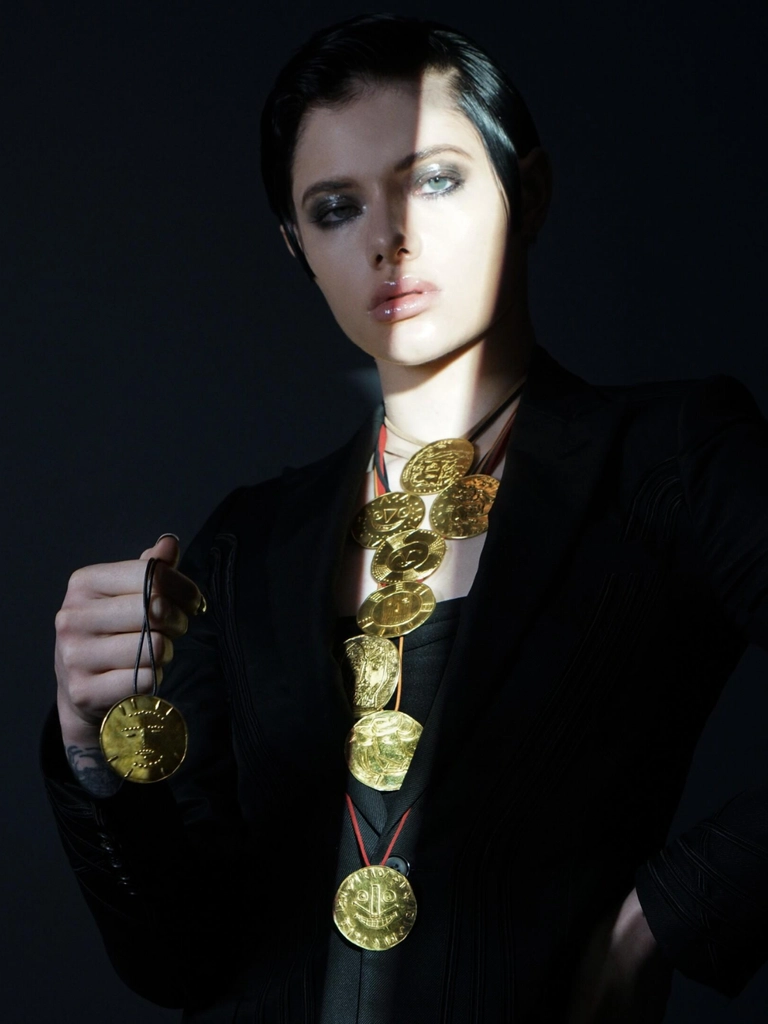
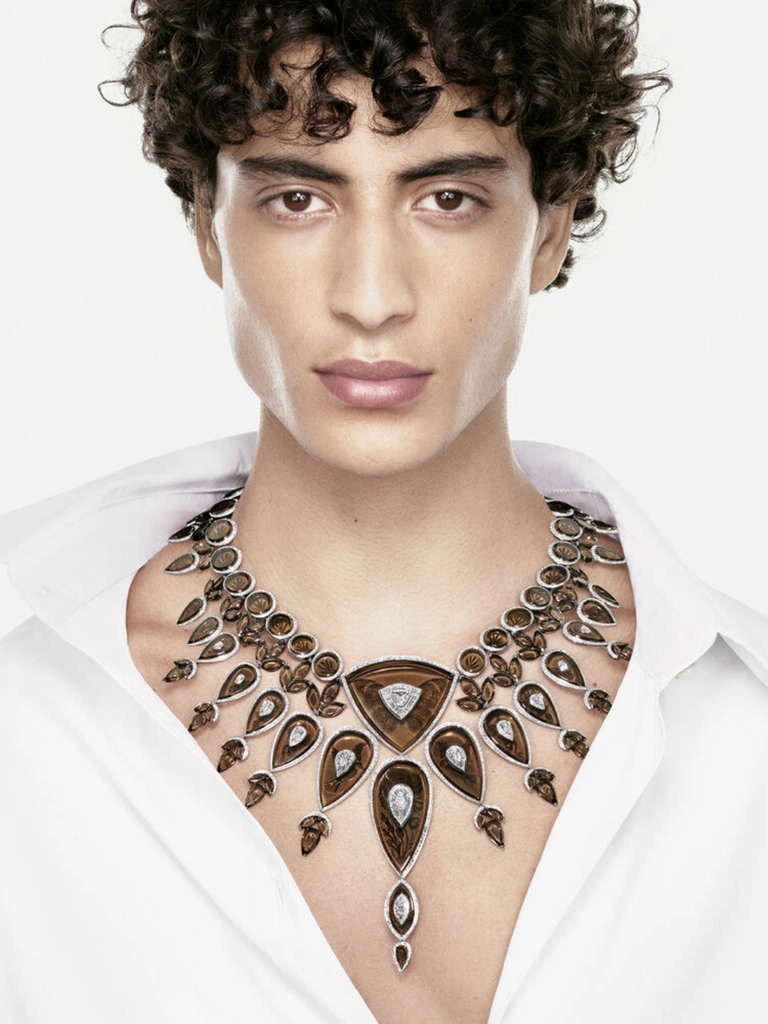
Tattoo pushes the jewel closer to the body by making it resemble ink beneath the skin. Across 580 carats of smoky quartz, a glyptic artisan carved Victorian-inspired motifs into the reverse of the translucent stones. Poppies, roses, birds, cicadas, snakes, butterflies and foliage emerge through variations in depth, relief and texture rather than applied color. As light passes through the quartz, the engraving appears to float forward as a softened silhouette.
The technical difficulty was severe. More than 200 tools were developed or adapted for the carving, with implements repeatedly wearing down against the hard quartz. The composition also had to remain symmetrical across multiple stones, meaning every hand-cut variation risked disturbing the whole. Tattoo creates individuality through disciplined repetition: it appears intimate and instinctive, yet it was built through thousands of controlled decisions.
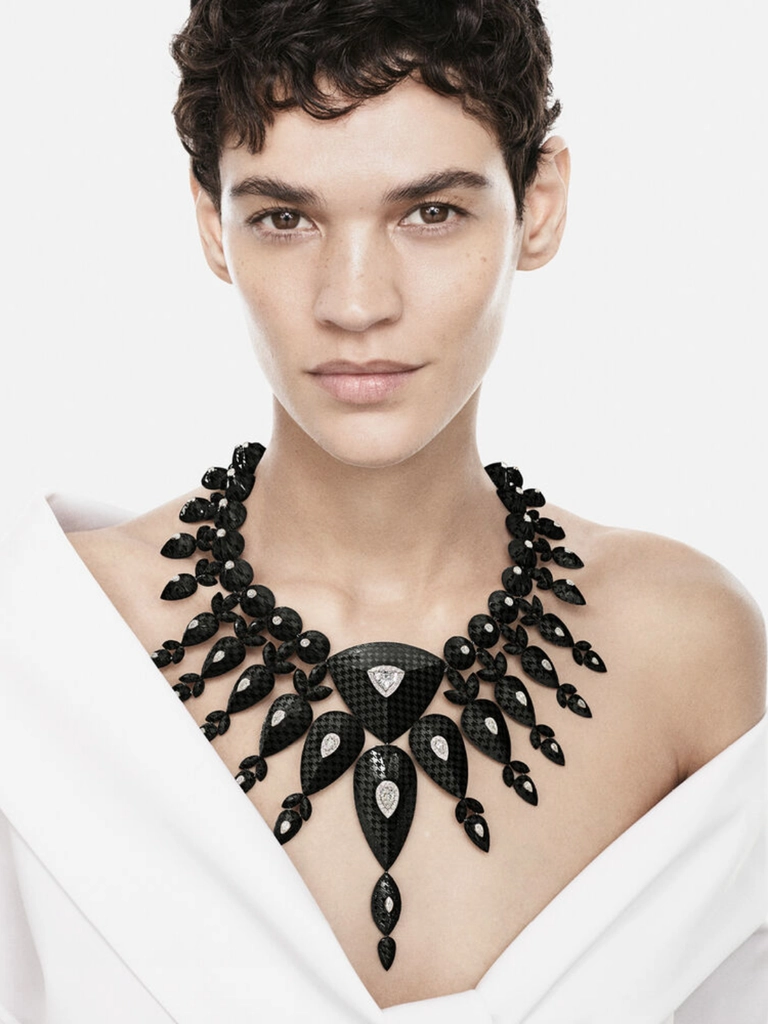
Checkers closes the sequence by returning jewelry to cloth. A houndstooth motif travels across 163 onyx elements as though a single length of fabric had been draped around the collarbone. The pattern evokes couture and also recalls Frédéric Boucheron’s family connection to the textile trade, but the result avoids nostalgia. It turns one of fashion’s most familiar graphics into an exercise in optical continuity.
Achieving that illusion required extensive CAD mapping and a femtosecond laser, a technology used in advanced watchmaking. Its ultrafast pulses remove material without producing the heat that could damage brittle onyx. Each stone required its own positioning and setting solution, while six central necklace elements were hollowed to reduce weight. The eye perceives one uninterrupted textile; the workshop sees 163 separate technical problems solved in sequence.
The five chapters ultimately describe more than five finishes. Rain is perception, Flower is memory, Light is intelligence, Tattoo is self-inscription and Checkers is culture worn close to the body. Their shared silhouette prevents those identities from becoming isolated fantasies. Every piece belongs to the same visual species, yet none can be mistaken for another.
That is why the Boucheron Human Being collection feels timely without collapsing into an anti-AI slogan. Its strongest claim is not that machines are incapable of producing beauty. It is that beauty becomes precious through responsibility: someone chose the pressure, accepted the risk, corrected the flaw and decided when the work was complete. Human judgment remains embedded in the object even when its supporting technology is highly advanced.
Boucheron closed the collection’s press dossier not with a triumphant inventory of total carats, but with the first names of more than sixty artisans, including Larissa, Marion and Coline. The gesture returns authorship to the people luxury communication often compresses into the anonymous word “craftsmanship.” Their identities become part of the jewel’s meaning.
Human Being therefore proposes a sharper definition of rarity. Stones may be scarce, tools can be improved and processes can be recorded. What cannot be reproduced exactly is the convergence of particular people, at a particular moment, making thousands of minute decisions together.