The horse remains almost invisible inside Hermès Into the Horsescape, yet its pulse travels through every curve. Pierre Hardy turns reins into diamond lines, hooves into black jade and a miniature saddle into titanium architecture, creating a high jewellery collection where equestrian heritage is sensed through movement, texture and the body.

The horse remains almost invisible inside Hermès Into the Horsescape, yet its pulse travels through every curve. Pierre Hardy turns reins into diamond lines, hooves into black jade and a miniature saddle into titanium architecture, creating a high jewellery collection where equestrian heritage is sensed through movement, texture and the body.
July 29, 2026


Hermès began in 1837 as a Parisian harness workshop serving a clientele whose first luxury objects were made for horses. Nearly two centuries later, the Maison returns to that origin for Hermès Into the Horsescape, its ninth haute bijouterie collection and its largest to date.
Created by Pierre Hardy, Creative Director of Hermès Jewellery since 2001, the collection contains 90 one-of-a-kind pieces arranged across 14 narrative sections. Its scale suggests a homecoming, although Hardy avoids a conventional parade of jewelled horses. The animal appears through traces left by movement, equipment and contact: the curve of a bit, the spinning path of a lasso, the arch of a hoof and the hard point of a blacksmith’s nail.
Hardy describes the collection as metonymic. The horse is represented through the objects surrounding it and the sensations associated with its body. Strength enters through bold volume. Speed appears in lines that sweep across the neck. Control is expressed through articulated structures that hold their shape while responding to movement.
The approach gives Hermès considerable creative freedom. Equestrian heritage no longer needs to be illustrated literally when its proportions, materials and physical tensions can build the jewel itself.
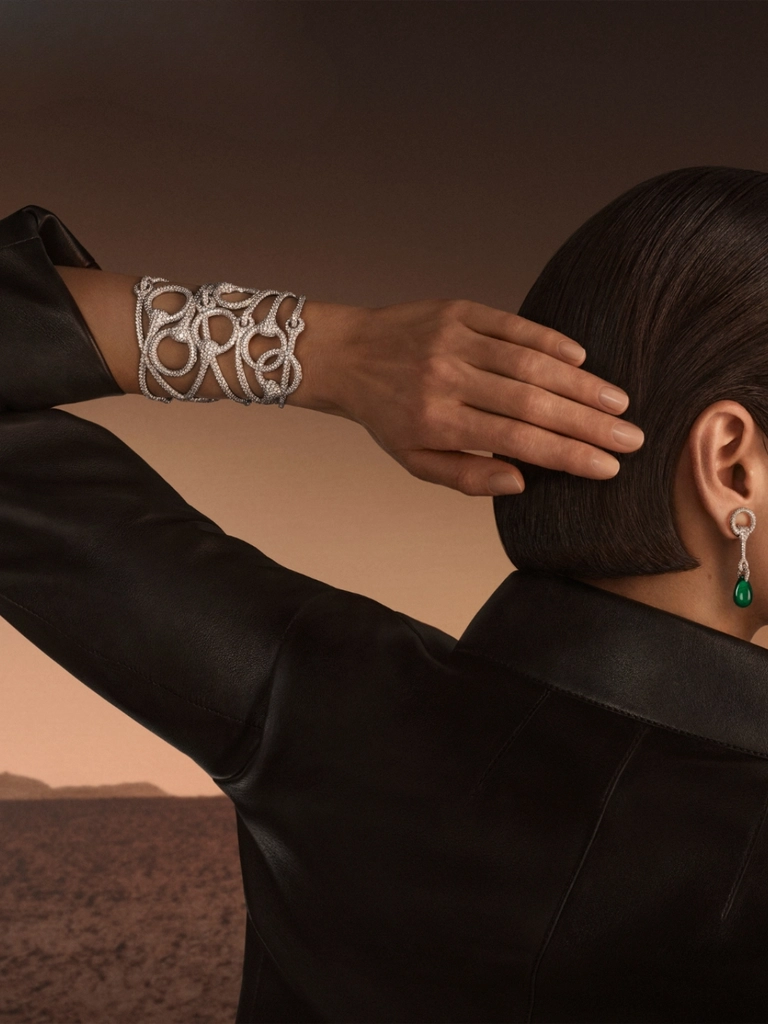
The Étreintes chapter transforms the sweeping curve of a horse bit into a series of necklaces, cuffs, earrings and rings. The French name suggests embraces, an appropriate description for forms that close around the body without appearing restrictive.

White gold and brilliant cut diamonds create clean, controlled arcs, interrupted by saturated emeralds. One necklace centres an 11.27 carat cabochon emerald, while matching earrings hold stones weighing 10.63 and 11.12 carats. Their smooth surfaces give the designs a depth distinct from the sharper scintillation of the surrounding diamonds.
The bit becomes unexpectedly sensual. Its original purpose involved pressure and direction, but Hardy softens its profile until it resembles an open gesture. Metal approaches the skin, curves away and returns, creating a rhythm between contact and space.
This physical intelligence runs throughout Hermès Into the Horsescape. Jewellery is considered through the complete silhouette, including how a shoulder turns, how a hand rises and how light travels across a moving neck. Hardy’s interest lies in the wearer’s presence within a room, allowing personal gesture to finish what the atelier began.
The lasso provides one of the collection’s most kinetic motifs. In Lasso Disco, baguette cut diamonds follow an intertwined route around the décolletage, recreating the spinning movement of rope before it is released.
A baguette diamond produces a long, disciplined reflection. Arranged in curved sequences, the stones transform rigid geometry into continuous motion. The necklace seems to circle the body even while resting in place, with every slight movement sending light along a new section of the line.

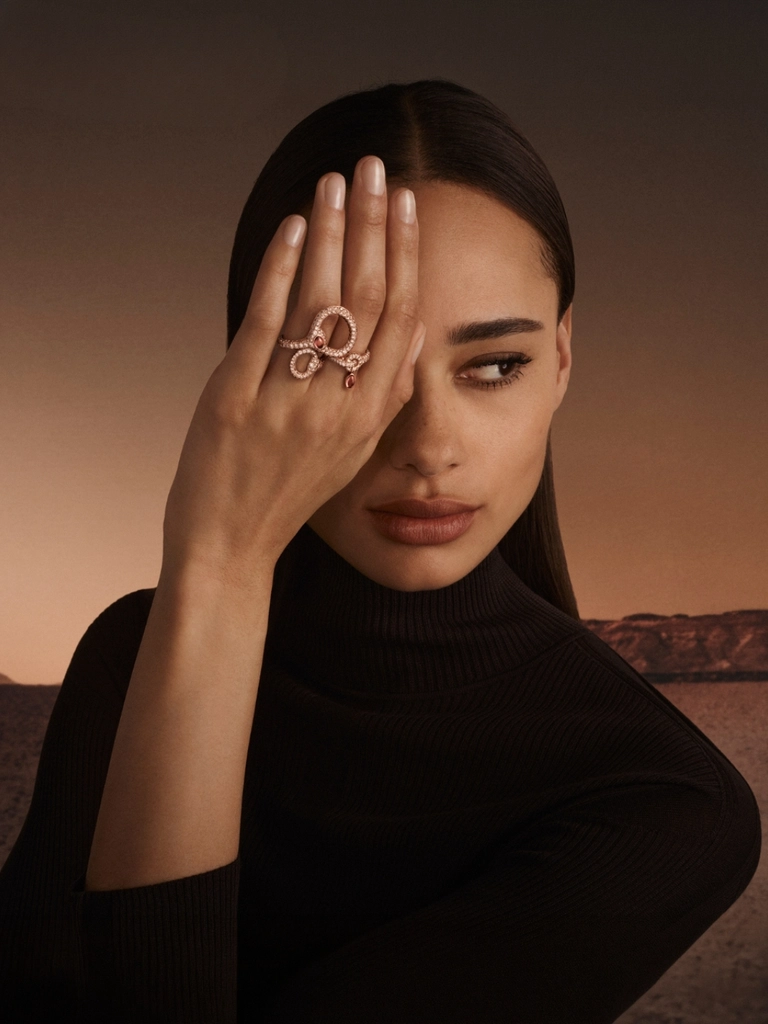
Fouet Double Tour develops a related idea through loops wrapped around the wrist or finger. One rose gold double ring is set with a 1.45 carat brilliant cut padparadscha sapphire, placing a warm pink orange stone inside a structure inspired by coiled riding equipment.
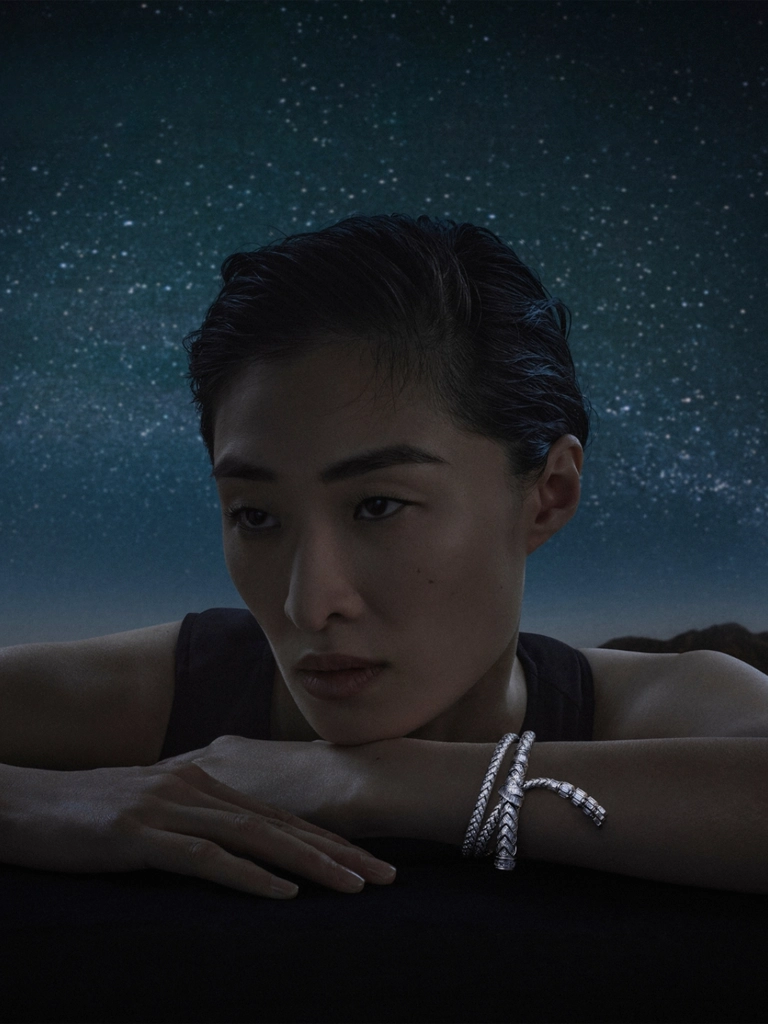
The playful “Disco” name prevents the collection from becoming overly reverential. The lasso enters the night, where its loops resemble light trails and its controlled rotation becomes a form of dance. Hermès acknowledges its history while allowing the symbolism to become glamorous, contemporary and slightly mischievous.
Sellette begins with an eighteenth century miniature saddle held in the Émile Hermès Collection. Hardy translates its construction into a bracelet combining gold, diamonds and satin finished black titanium.
Titanium allows the piece to achieve dramatic scale with reduced weight. Its dark surface recalls leather while maintaining the precision of metal, turning the saddle into an intricate piece of wrist architecture. The open framework suggests straps, supports and sections of carefully assembled tack.
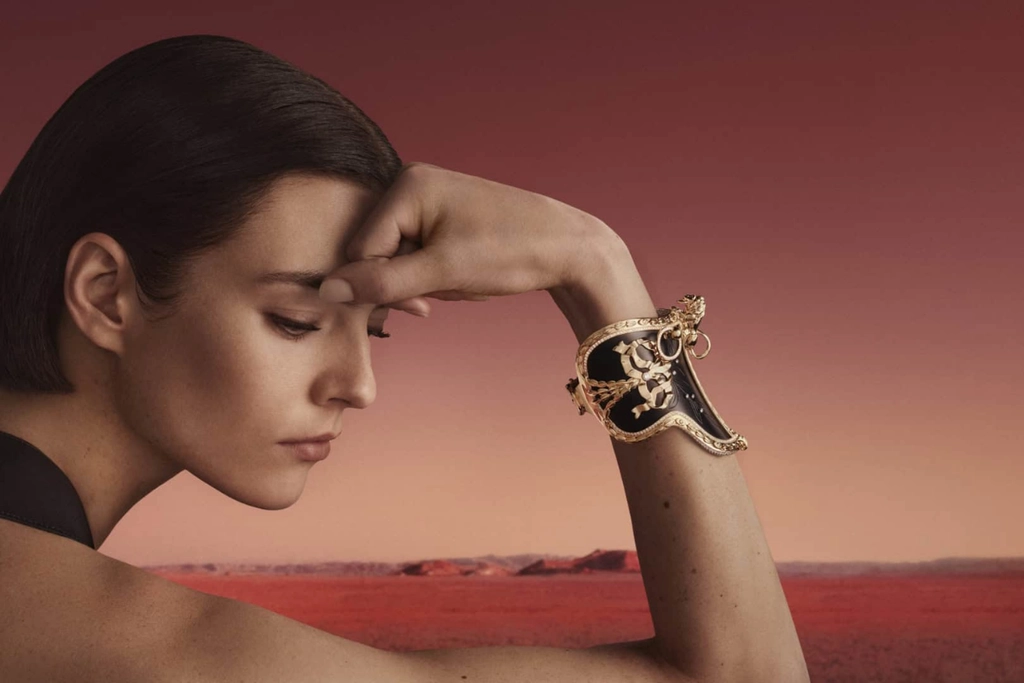
The bracelet demonstrates the depth of the Maison’s archive. An old object is examined for the intelligence of its construction, then rebuilt according to the demands of the human body. Historical accuracy gives way to physical memory: the saddle’s layered form, polished surfaces and relationship with movement.
The jewel also reverses the original exchange between horse and rider. An object once placed across an animal’s back returns in miniature to the person’s wrist, carrying its shape into a new scale and purpose.
The equestrian palette extends beyond recognisable equipment. Black jade echoes the polished curve of a hoof, while Tahitian pearls contribute a similarly deep lustre. Rose gold and brown diamonds recall glossy coats touched by warm light. Smoky quartz, brown tourmalines, tiger’s eye, moonstones and opals introduce colours associated with leather, earth and changing animal skin.
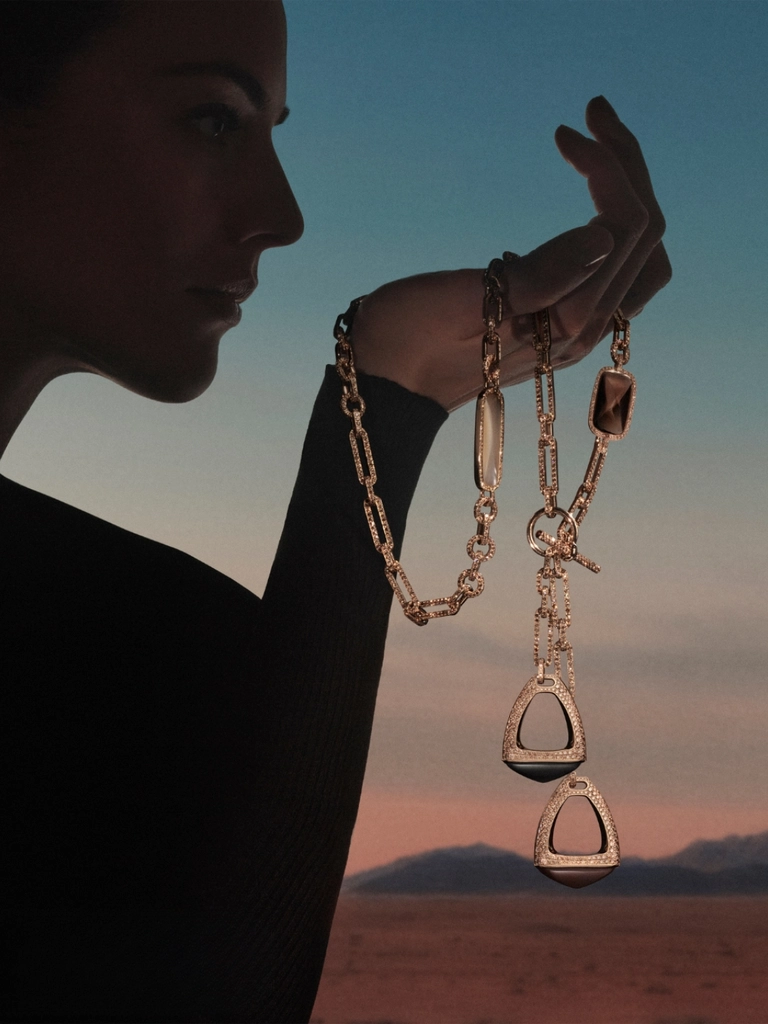
The Étriers pieces use the stirrup as a repeating geometry. A long yellow gold necklace combines black jade, smoky quartz, moonstones, white diamonds and brown diamonds, moving through cream, black and earthen tones like a complete equestrian material library.
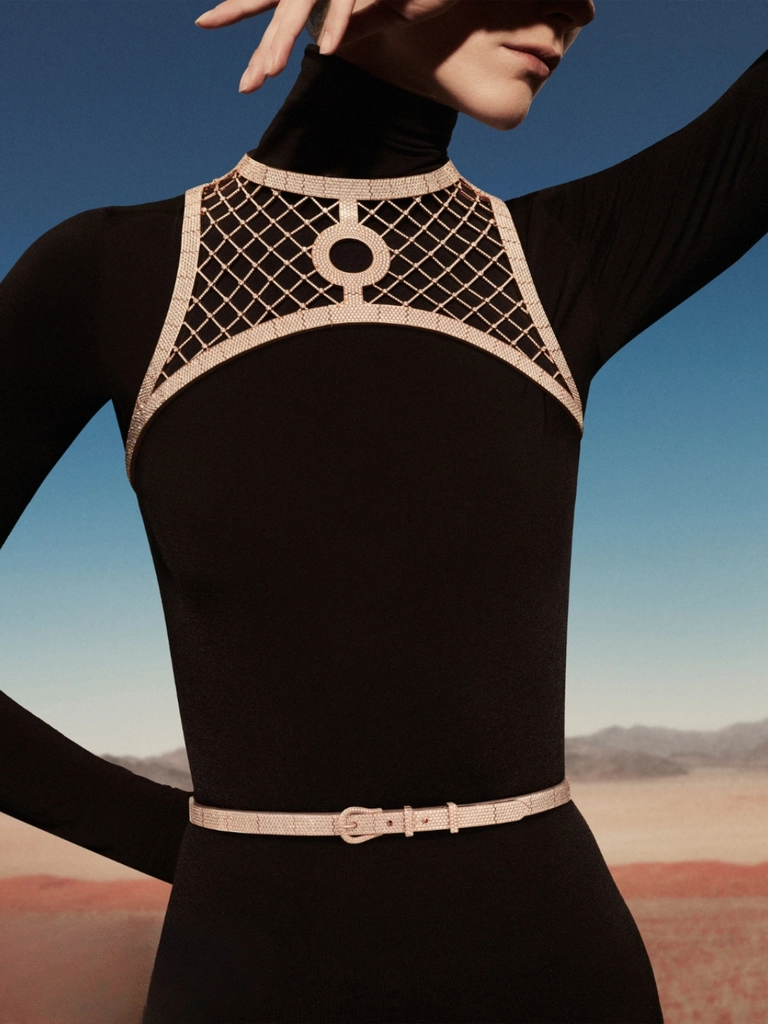
Clou de Forge Lumière begins with the blacksmith’s nail used in shoeing a horse. Hardy enlarges and multiplies its pointed form until it becomes a radiating structure paved with diamonds. An item normally associated with impact, weight and manual labour is transformed into light around the face and neck.
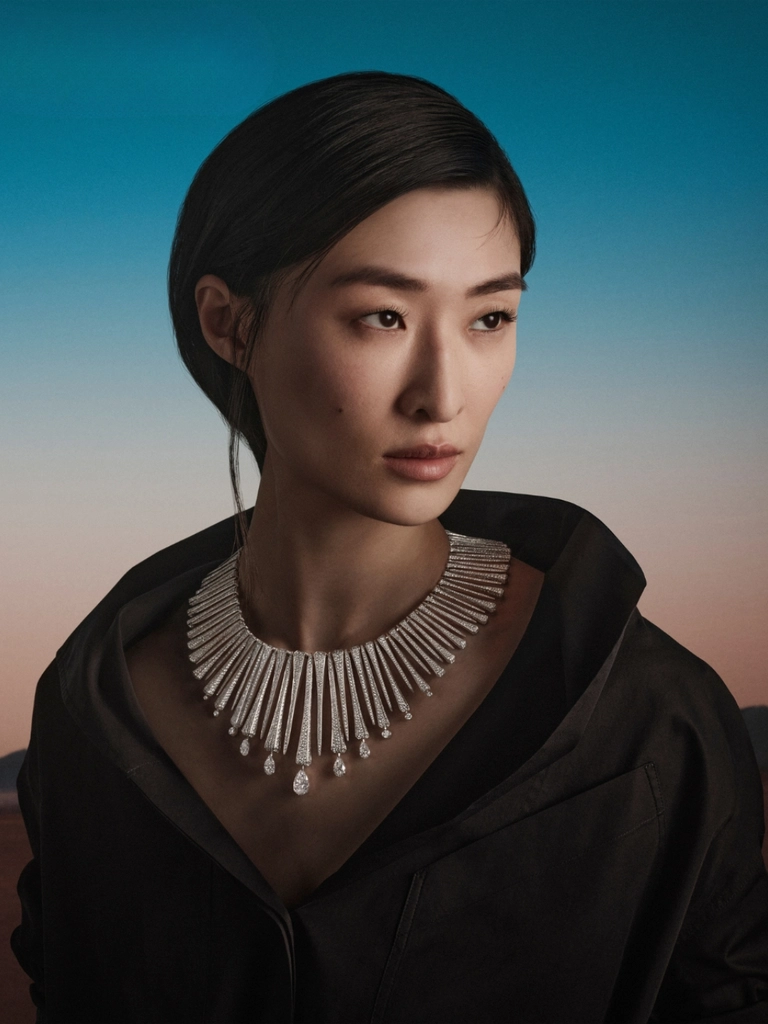
Hermès has explored the Clou de Forge in its broader jewellery lines, describing beauty as something born from usefulness. The high jewellery interpretation pushes that philosophy towards spectacle without losing the nail’s direct, elemental shape.
The animal becomes more visible in Galop Hermès. A double ring brings two sculptural horse heads together, reducing their profiles to polished volumes and controlled curves. The design captures the strength of the forehead, the direction of the muzzle and the moment of encounter between two bodies.
Even here, Hardy avoids excessive detail. The horse is identified through silhouette and momentum, continuing the collection’s preference for suggestion. Its anatomy becomes an abstract structure that can cross two fingers without slipping into miniature figurative sculpture.
Cavale carries equestrian motion into darker territory through rose gold, black rhodium, grey and black spinels and diamonds. The tonal progression creates the impression of speed passing through shadow, expanding the collection beyond the familiar polished warmth of traditional riding imagery.

The collection arrives at a moment of considerable strength for the Maison. Hermès reported revenue of €16.002 billion for 2025, while the broader Other Hermès Sectors division, which includes jewellery and home objects, represented 6 per cent of consolidated sales. High jewellery operates as a relatively small but symbolically powerful part of the business, displaying skills, ideas and materials at their most concentrated level.
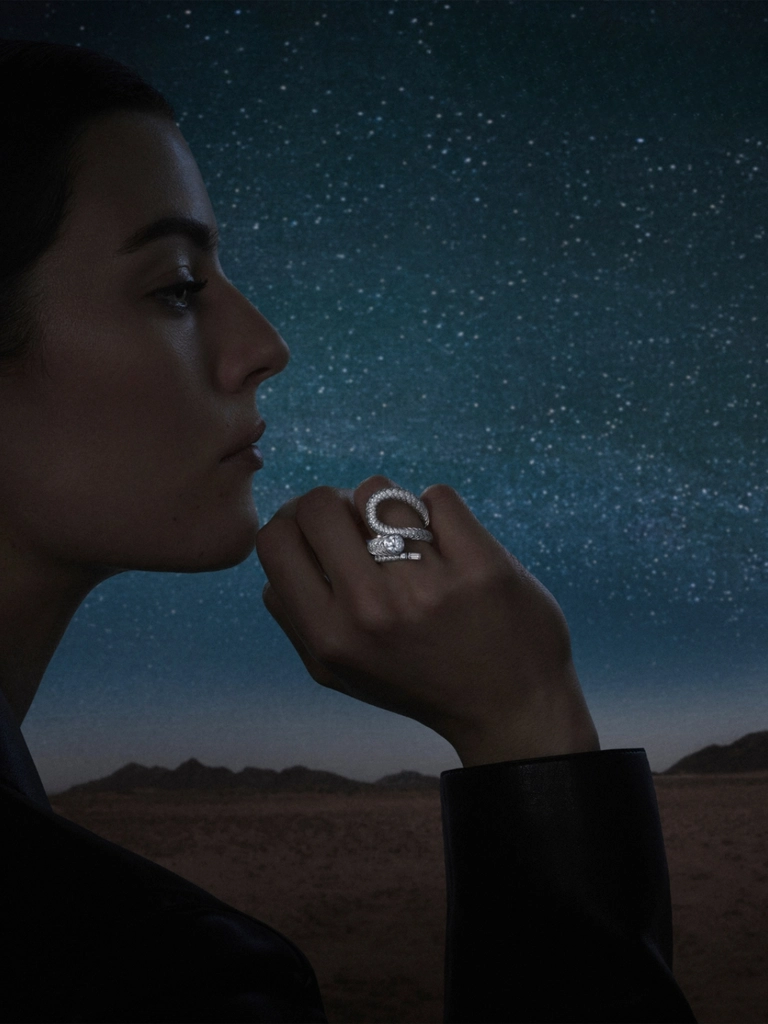

Into the Horsescape also follows Les Formes de la Couleur, Hardy’s eighth haute bijouterie collection, which examined the relationship between geometry, gemstone colour and the perception of light. The new collection brings that experimental confidence back into Hermès’ foundational universe. Colour remains important, but it now describes coats, hooves, leather and earth. Geometry is placed in the service of reins, saddles and motion.
The achievement of Hermès Into the Horsescape lies in how little it needs to show. A horse does not have to appear in full when its energy is already present in a diamond curve, a titanium saddle or a black jade hoof. Pierre Hardy allows the Maison’s oldest story to surface through function, memory and touch, creating jewellery that carries the horse long after the animal has disappeared from view.