MENU
Close





Some places feel designed for living, others for sensing. At the intersection of art and architecture, when architects and artists share authorship from the first sketch, a building stops behaving like a container and starts becoming a liveable experience.
Some places feel designed for living, others for sensing. At the intersection of art and architecture, when architects and artists share authorship from the first sketch, a building stops behaving like a container and starts becoming a liveable experience.
January 28, 2026


When art and architecture sit in the same room, the conversation often begins with practicalities and ends somewhere stranger. The architect speaks in weight, structure, circulation, and time. The artist speaks in feeling, perception, narrative, and the kind of surprise that arrives before language. When this conversation matures, the boundary between art and architecture dissolves, and the result: A liveable artpiece.
This era of cross-industry collisions has turned the professional world into a giant, high-stakes chemistry set: We have seen architects venturing to fashion with surprising grace. Meanwhile, artists are moving beyond the canvas to reimagine entire city blocks . It turns out that when you let a bridge designer build a shoe, or a painter design a plaza, you get results that are as strange as they are spectacular.
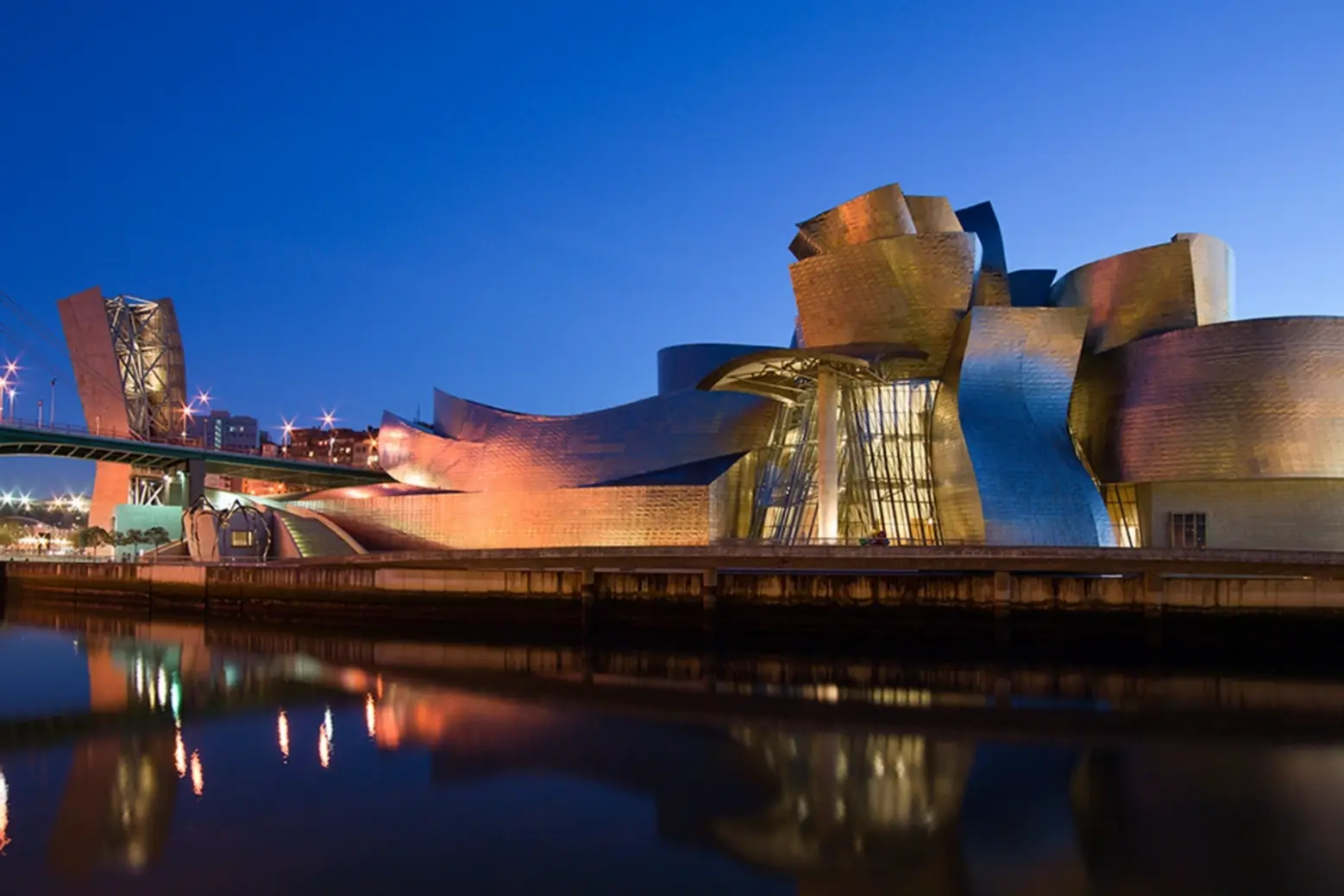
On the banks of the Nervión River, Frank Gehry’s Guggenheim Bilbao rises like a titanium dream caught mid flight, a shimmering landmark that helped pull a whole city into a new future. Inside this fluid world, the museum stages a dialogue between two sculptors who speak in entirely different registers: Richard Serra and Louise Bourgeois. Serra’s language is physical. Bourgeois speaks to the psyche.
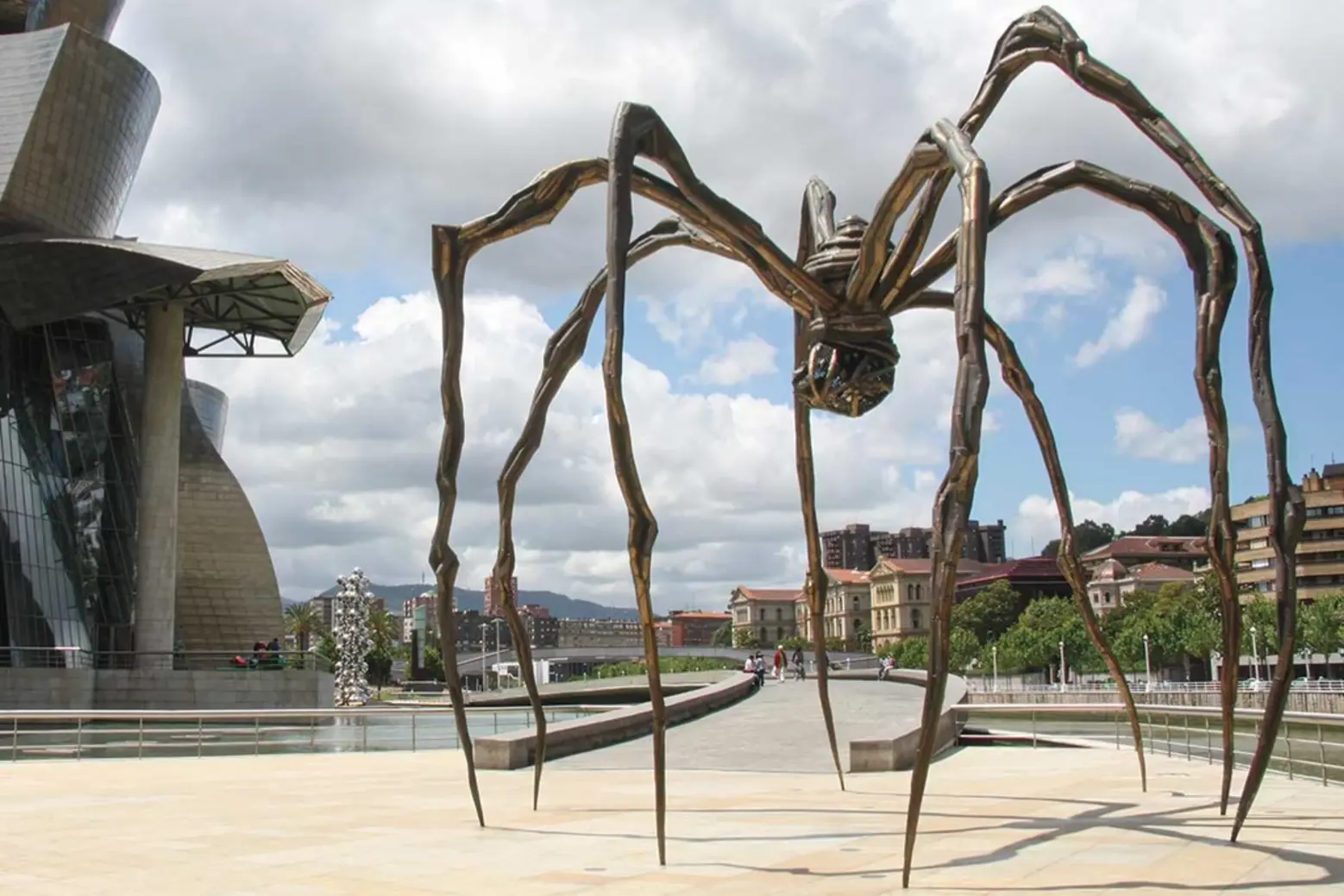
That tension becomes instantly visible outside, where Louise Bourgeois’ Mamanstands near the water like a dark, elegant gatekeeper to Gehry’s metallic bloom. The spider is monumental, yet strangely fragile, long legs poised with the delicacy of a line drawing. It is also deeply personal. Bourgeois cast the spider as a tribute to her mother, a weaver and tapestry restorer, transforming a creature often framed as terrifying into a symbol of protection, patience, and intricate intelligence. Against Gehry’s sweeping, muscular architecture, Maman brings a necessary biological counterpoint.
Then you step into the heart of the building, where the central atrium opens like a fifty meter high metallic flower, petals spiraling into galleries that refuse the old discipline of straight lines. This is the museum’s true theater, a space designed to host work that can match the building’s intensity. Serra enters here like weather. In a cavernous gallery conceived for his scale, The Matter of Time unfolds as a trapped storm system of steel, a sequence of torqued forms that pull you forward, tilt your sense of balance, and make direction feel negotiable.
The Harpa Concert Hall stands like a crystalline cliff rising from the North Atlantic. It is a rare moment where architectural clarity and artistic soul merge perfectly: the result of a high-stakes collaboration between Henning Larsen Architects and Olafur Eliasson.
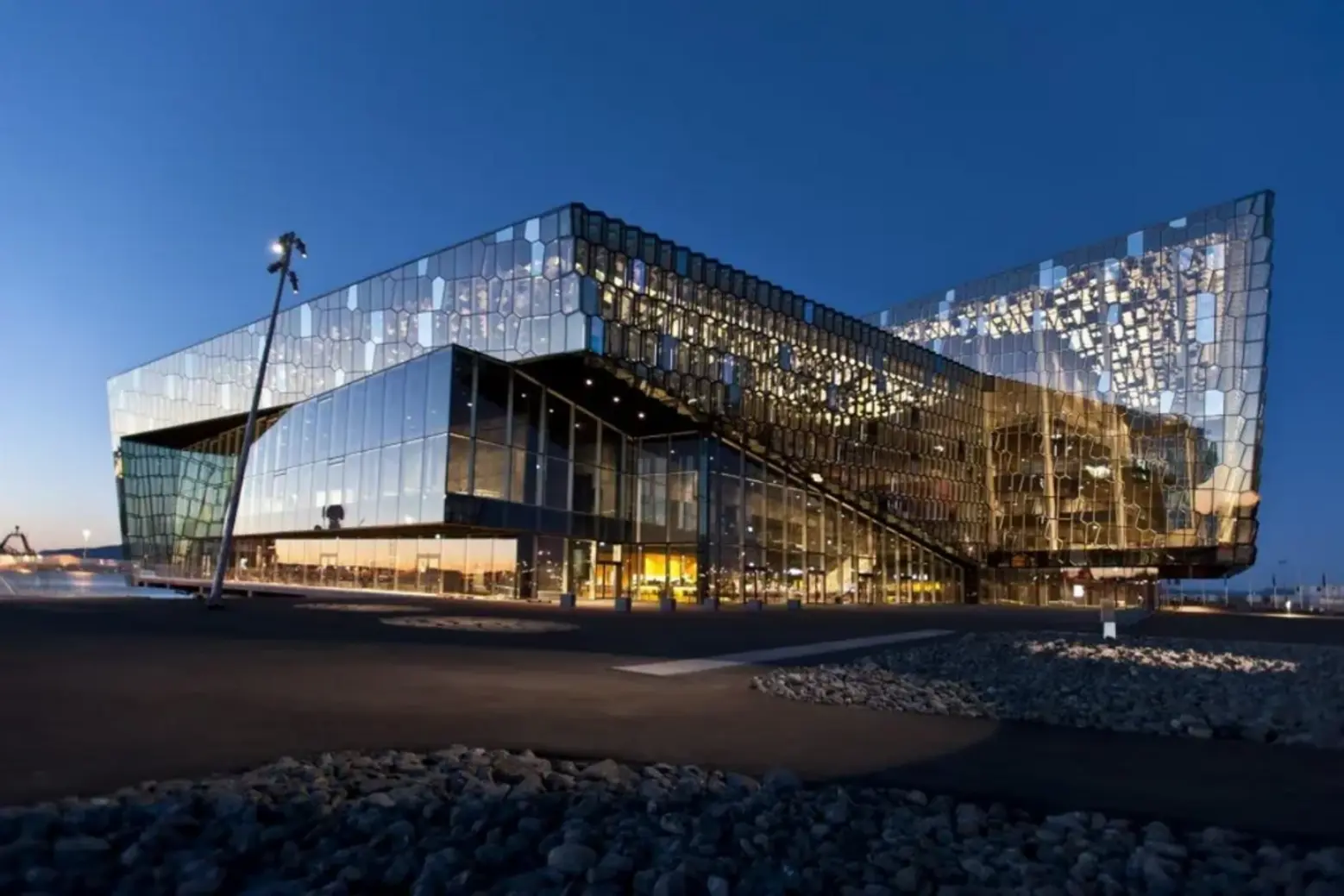
The building announces itself through its facade: a shimmering, three-dimensional field of over 1,000 "quasi bricks." These 12-sided polyhedrons, developed by Eliasson and geometer Einar Thorsteinn, were inspired by the hexagonal basalt columns of Iceland's volcanic landscape.
On grey days, Harpa acts as a muted mirror to the sea. On clear days, the color-effect filter glass turns the facade into a prism of yellow, orange, and green. By night, the building transforms into a lantern, capturing the essence of the Northern Lights and reflecting the interior glow back to the city.
While the exterior captures the cool, shifting atmosphere of the Arctic, the heart of the building is an intentional, dramatic contrast. The main concert hall, Eldborg (translated as "Fire Mountain"), is finished in a deep, fiery red. It is designed to feel like a magma chamber hidden deep within a shell of ice and rock - a nod to the volcanic power that defines Iceland’s identity.
The Harpa Concert Hall’s story is as much about survival as it is about aesthetics. Construction began in 2007, just before the Icelandic financial crisis hit. For years, the building stood as a lonely steel skeleton - the only active construction site in a frozen economy. When it finally opened in 2011, it became a powerful symbol of national recovery.
While the collaborations of Eliasson and Thorsen focus on the permanence of light and stone, the partnership between artist Anish Kapoor and Pritzker Prize-winning architect Arata Isozaki produced something entirely different: A building that travels. Ark Nova is the world's first inflatable, mobile concert hall.
Born as a direct response to the 2011 Tōhoku earthquake and tsunami in Japan, the project’s name translates to "New Ark." Just as the ancient ark was a vessel to save life from the flood, Ark Nova was conceived as a vessel to save "culture and spirit." In the wake of a disaster that leveled theaters and community centers, Kapoor and Isozaki realized that healing required a space for shared experience. The duo’s commitment to healing is integrated into the very materials of the hall. In a deeply poetic move, the interior benches and acoustic reflectors were crafted from Japanese cedar trees killed by the 2011 tsunami.
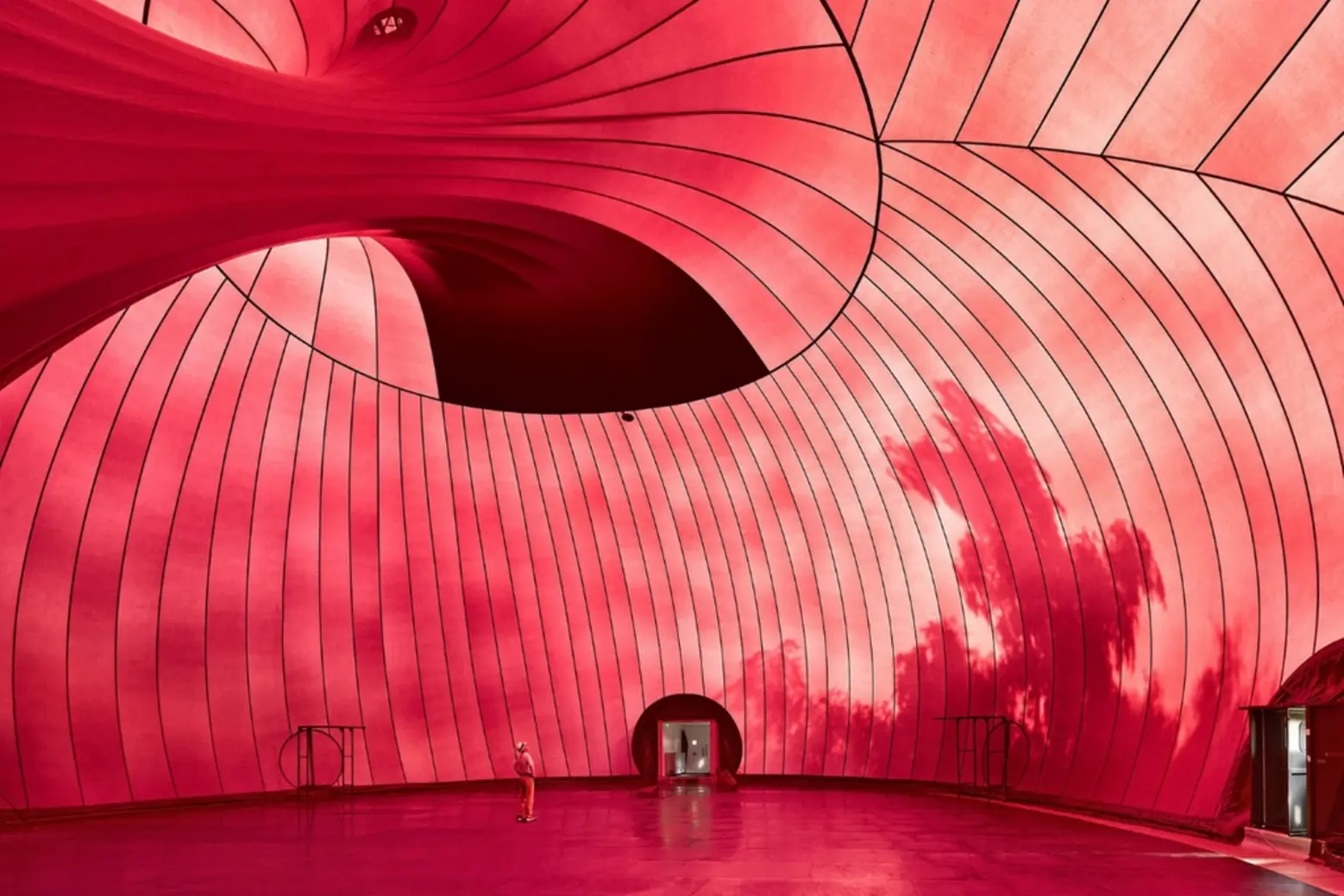
The structure is a feat of divergent thinking. It is a 1.7-tonne sculpture made of a single, continuous PVC-coated polyester membrane: no steel beams, no concrete pillars. Held aloft entirely by air pressure, it resembles a giant, translucent purple bean, or what Kapoor calls a "Leviathan." Inside, the experience is otherworldly. The membrane filters daylight into a deep, warm red glow, creating a womb-like atmosphere that feels both intimate and immense. Isozaki’s architectural discipline ensures that this mystery serves a purpose: the "donut" shape is a structural stroke of genius, where the center folds in on itself to form a massive internal column, stabilizing the roof without obstructing the performance logic required for a real audience.
Ark Nova redefines architecture as a nomadic force, detaching high art from fixed foundations. Its efficiency is striking: the entire hall deflates for transport on a single truck and inflates via three fans in just one hour, instantly converting any empty lot into a world-class venue.
Following a decade of service in Japan’s tsunami-hit regions, its 2025 European debut at the Lucerne Festival solidified its status as a global symbol of resilience. Ark Nova acts as a portable instrument of healing, proving that community and beauty can create a "home" anywhere.
Together, these projects show how powerful art and architecture become when they stop standing alone. What unites these iconic pairings is authorship without hierarchy. Architecture provides structure and endurance. Art brings emotion, vulnerability, and meaning. When the two worlds collide, the result is neither building nor sculpture alone, but a place that stays with you long after you leave.